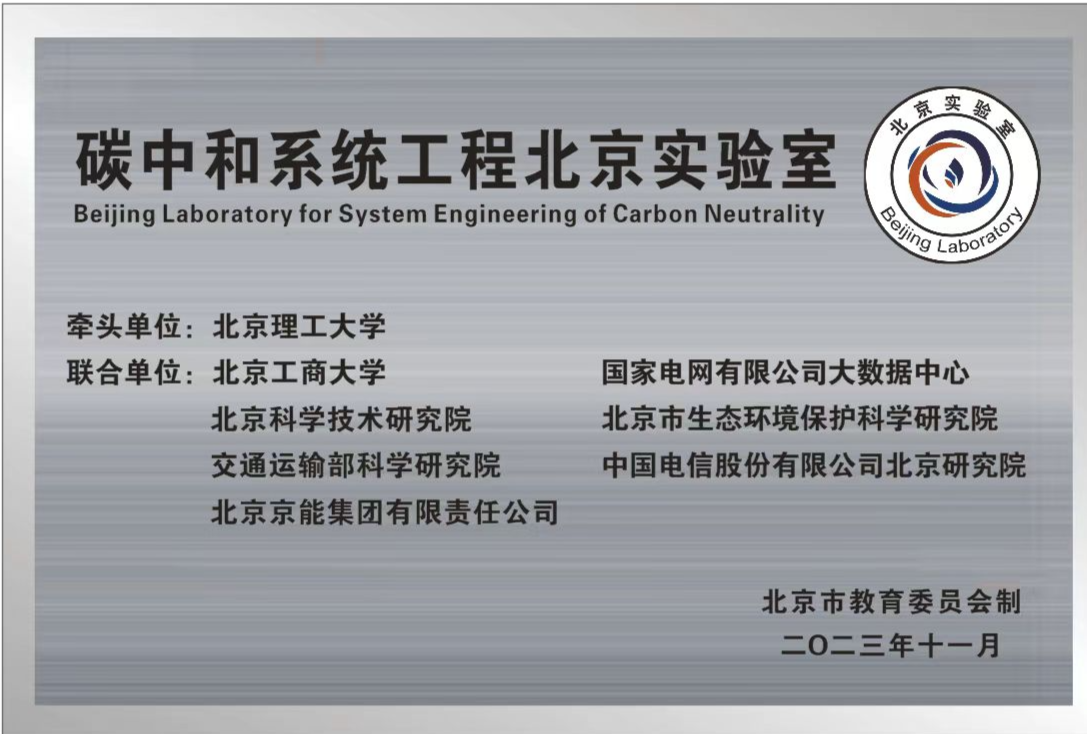
In 2023, the Beijing Municipal Education Commission officially recognized the "Beijing Laboratory for Systems Engineering of Carbon Neutrality." The laboratory is affiliated with the Center for Energy and Environmental Policy Research, Beijing Institute of Technology. Beijing Laboratories were initiated in 2012, and a total of 20 have been approved for construction to date. The "Beijing Laboratory for Systems Engineering of Carbon Neutrality" is one of the four Beijing laboratories newly established in 2023. The Director of the Laboratory is Professor Yi-Ming Wei, an expert in energy and environmental systems engineering, recipient of the National Science Fund for Distinguished Young Scholars, and Distinguished Professor of Beijing Institute of Technology.
The Laboratory serves the implementation of carbon neutrality goals for China, the Beijing-Tianjin-Hebei region, and Beijing Municipality. It conducts basic theoretical research, technology development, and systems engineering in areas including accelerating the low-carbon transition of energy systems, tackling key technologies for CCUS and negative emissions, promoting the synergistic enhancement of pollution reduction and carbon reduction, building a carbon-neutral low-carbon technology system, advancing energy conservation and consumption reduction, improving carbon neutrality management efficiency in metropolitan areas, and building a carbon neutrality technology platform, to achieve new breakthroughs in carbon neutrality fundamental theories and key technologies and provide scientific methods, technical support, and decision-making support for the national carbon neutrality strategy and Beijing's green transition.
The Laboratory establishes innovative research departments around key directions.
Innovative Research Department for Complex System Modeling of Carbon Neutrality in the Capital Metropolitan Area: As China has committed to achieving carbon neutrality, cities—especially metropolitan areas—will play a key role in realizing carbon neutrality goals. As a major systemic transformation, carbon neutrality will comprehensively and profoundly affect the economic development and resource environment of metropolitan areas. The Department focuses on complex system modeling for metropolitan carbon neutrality, explores urban micro-scale multi-agent interaction mechanisms, assesses low-carbon transition risks in the capital, designs and develops an urban simulator covering climate, environment, energy, economy, and technology dimensions, and ultimately proposes capital carbon neutrality pathways that take into account both synergistic pollutant reduction and sustainability improvement.
Innovative Research Department for Low-Carbon and Secure Transition of Energy Supply: The "Beijing 14th Five-Year Plan and 2035 Outline" proposes systematically advancing energy transition and building a strong, resilient, green, low-carbon, and smart energy system. The "Beijing 14th Five-Year Energy Plan" emphasizes dedicating full efforts to tackling a batch of green and low-carbon key core technologies and equipment and building a source and highland of energy technology innovation. The Department focuses on the low-carbon and secure transition of energy supply, carries out foresight on low-carbon technologies such as energy storage, hydrogen energy, and microgrids, develops new models for smart energy park construction, optimizes the energy supply system of metropolitan areas in the carbon neutrality era, and proposes low-carbon, secure, and smart energy supply and reserve schemes suitable for the capital region.
Innovative Research Department for Industrial and Building Energy Conservation and Smart Transportation: The report of the 13th Beijing Municipal Party Congress pointed out the need to promote the green and low-carbon transformation of the industrial structure, promote green buildings, strengthen energy-saving renovation of existing buildings, and develop ultra-low energy consumption buildings according to local conditions; the "Beijing 14th Five-Year Plan and 2035 Outline" emphasizes deeply promoting low-carbon development in energy, industry, buildings, and transportation. The Department focuses on industrial and building energy conservation and smart transportation, conducts research on theories and methods for coupling energy structure and industrial layout oriented toward carbon neutrality, develops digital simulation and low-carbon regulation technologies for high-energy-consumption and high-emission enterprises and production processes, designs low-carbon standards systems for the building and transportation sectors, and proposes economic system and industrial structure optimization pathways suitable for green and low-carbon development in the capital region.
Innovative Research Department for Negative Carbon Technology R&D and Industrial Layout: The "Beijing Carbon Peak Implementation Plan" emphasizes leveraging the large-scale emission reduction potential of negative carbon technologies such as CCUS and advancing their R&D and industrial demonstration applications. The Department conducts research on technology innovation management and engineering management in the fields of CCUS and negative emission technologies. It carries out short-, medium-, and long-term development pathway planning for CCUS and negative emission technologies in high-energy-consumption industries, and designs national and regional CO2 dynamic pipeline network planning and infrastructure construction schemes. It conducts tackling research on feasibility analysis, investment and risk management, investment decision-making and evaluation, and business model design for key engineering projects of CCUS and negative emission technologies. It promotes the deployment of CCUS and other negative carbon technologies in key emission sectors in Beijing and carries out related engineering demonstrations.
Innovative Research Department for Computing Power–Electric Power–Thermal Power–Carbon Power Synergy: Computing power is the cornerstone of future strategic emerging industries and new quality productive forces. The "scale" of data centers—key computing infrastructure in China—continues to expand, and the accompanying problems of "energy consumption and carbon emissions" are becoming increasingly prominent. In the context of carbon peak and carbon neutrality, properly handling the relationship between computing power construction, energy security, and green development has become crucial to China's high-quality economic development. In the future, the core challenge of green and low-carbon development of data centers lies in how to coordinate and optimize the productive forces and production relations of computing power, electric power, thermal power, and carbon power at the macro, meso, and micro levels. The Department is committed to exploring the concept, connotation, and extension of "computing power–electric power–thermal power–carbon power" synergy under low-carbon development and new energy systems. From the interdisciplinary perspective of intelligent computing, electric power, thermal energy, and management and economics, it studies the strategies, pathways, technologies, and equipment for the interaction, coupling, and synergy of "computing power–electric power–thermal power–carbon power" in the upstream, midstream, and downstream of data centers, promotes the low-carbon transition of data centers, and consolidates the computing power foundation of new quality productive forces.
Innovative Research Department for Integrated Territory-Wide Carbon Monitoring: High spatial and temporal resolution carbon monitoring is an important means and basic prerequisite for achieving carbon peak and carbon neutrality. How to monitor online the territory-wide carbon source emissions and absorptions at different spatial scales (space–ground–underwater) and form networked, integrated smart supervision based mainly on standards systems, evaluation systems, early warning systems, and scientific guidance systems has become a key problem urgently to be solved. The Department conducts frontier research in areas such as territory-wide carbon sensing and monitoring, carbon footprint management, and carbon neutrality management standardization. Targeting key industries such as transportation (aerospace, railway, water transport, and highway), manufacturing, mineral energy, and environmental governance, it tackles key technologies including carbon neutrality monitoring and management, carbon sinks, carbon footprint databases and management, and carbon emission accounting and evaluation.