


On September 10‑11, 2026, Zheng Guoliang, a PhD candidate from the Center for Energy and Environmental Policy Research at Beijing Institute of Technology (CEEP‑BIT), was invited by Resources for the Future (RFF) to attend the Solar Radiation Modification (SRM) Social‑Science Workshop co‑hosted by RFF and Harvard University in Washington, D.C., USA.
During the workshop, Zheng Guoliang had in‑depth exchanges with interdisciplinary experts and scholars on solar geoengineering‑related topics including SRM risk management, climate economics and decision science. He delivered the research presentation Managing Termination Shock Risk of Solar Geoengineering in a Warming World in the opening special session of the conference. His presentation extended the dynamic integrated climate‑economy assessment model by incorporating the risk of abrupt SRM termination. It explored optimal pathways for the coordination between SRM and carbon mitigation, and proposed forward‑looking policy measures to address climate and economic risks triggered by sudden SRM termination.
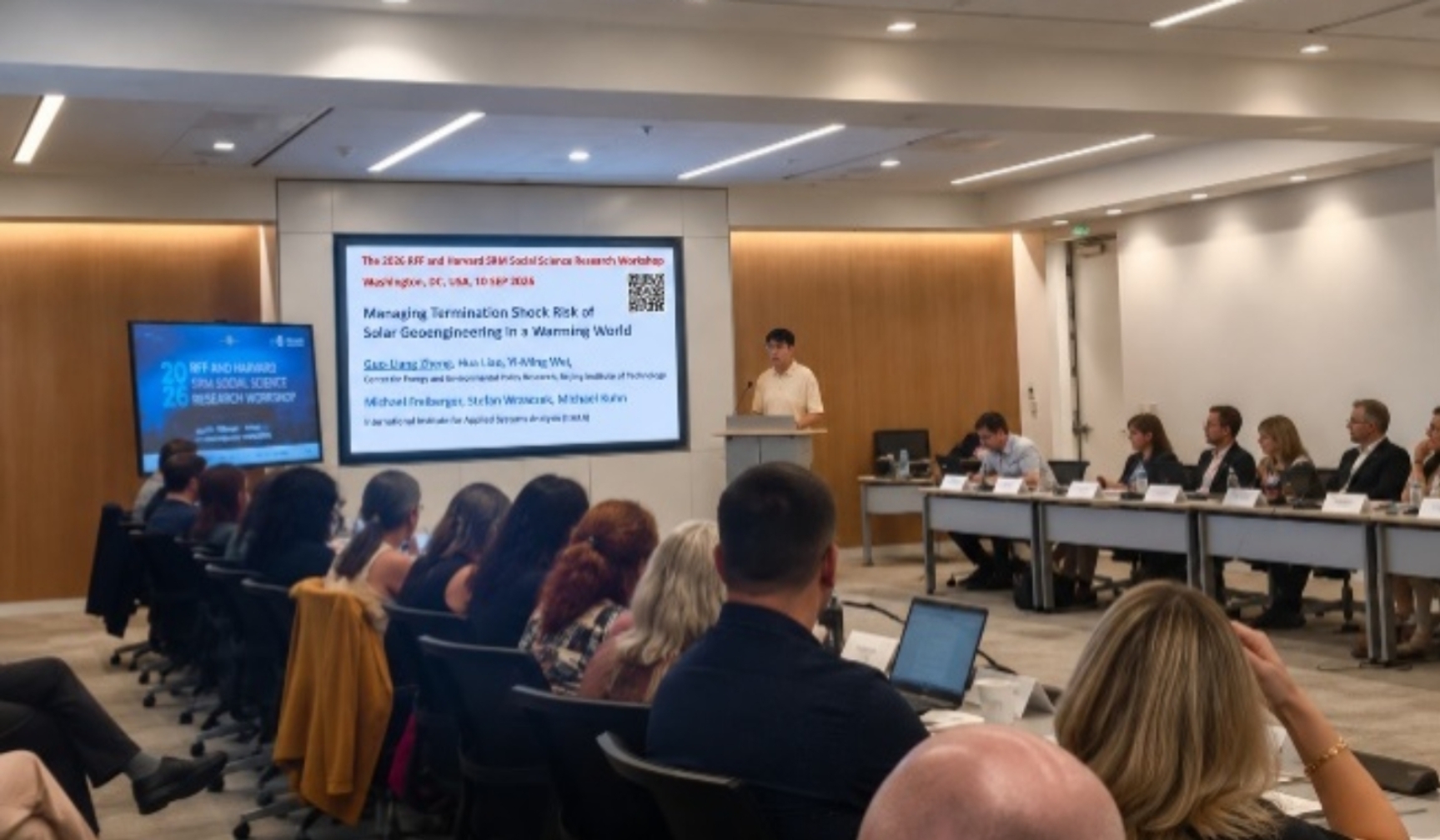
(PhD candidate Zheng Guoliang presenting at the RFF‑Harvard SRM workshop)
This high‑profile workshop has been co‑hosted annually by RFF and Harvard University since 2023, bringing together leading experts in the field. The 2026 event marks its fourth edition, with discussions centering on SRM termination risks, public perception and decision‑making, research governance, and global governance. Participation is by invitation only, and round‑trip travel expenses for presenters are covered by the conference organizers. More than 40 scholars from institutions including RFF, Harvard University, Princeton University, Duke University, and the European Institute for Environmental Policy took part in this year’s workshop. Zheng Guoliang is the first presenter from a Chinese institution since the inaugural 2023 workshop, and also one of the very few student presenters invited.
In recent years, CEEP‑BIT has carried out research on risk‑related decision‑making for solar geoengineering. Preliminary research outputs have been published in peer‑reviewed journals or presented at conferences such as the Annual Conference of the World Association of Resource and Environmental Economists and the Annual Meeting of the American Economic Association. Previously, from May 27‑29, 2026, Zheng Guoliang was also invited to give an academic presentation at the Solar Radiation Modification Research Governance Forum organized by the EU Horizon Europe Co‑CREATE project in Brussels, Belgium.
Founded in 1952, Resources for the Future (RFF) is a world‑renowned resource‑and‑environmental think tank. Harvard University is among the earliest higher‑education institutions to conduct SRM‑related research and experiments. RFF and Harvard University launched their respective solar geoengineering research programmes in 2020 and 2017, aiming to deepen understanding of SRM risks, potential benefits and other associated uncertainties.
Appendix: Conference webpage link https://www.rff.org/events/conferences/2026-rff-and-harvard-srm-social-science-research-workshop/
