


From November 11 to 13, 2025, the 18th Annual Meeting of the Integrated Assessment Modeling Consortium (IAMC) was held in Rio de Janeiro, Brazil. Five members from the Center for Energy and Environmental Policy Research at Beijing Institute of Technology (CEEP‑BIT), including post‑doctoral researcher Wu Yun, doctoral candidates Yang Bo, Zhao Yang, Wang Hao and Hu Yuxiang, attended the meeting. They presented research outputs in multiple parallel sessions on the opening day and conducted in‑depth exchanges with international peers.

Group Photo of the CEEP‑BIT Team
The opening ceremony featured addresses by Professor John Weyant from Stanford University and Professor Detlef van Vuuren from the Netherlands Environmental Assessment Agency. They highlighted how outcomes from integrated‑assessment‑modeling (IAM) research contribute to COP climate summits and updates to IPCC reports. The plenary session centered on “Reflections on Phasing‑out Fossil Fuels”. Guests including Brazil’s former Minister of Finance and former Congressman discussed ways to translate global climate pledges into concrete action pathways, and elaborated on critical elements such as technology, policy and finance. In the subsequent “Community Projects” segment, researchers from multiple institutions showcased innovations of IAM models in global scenario design and model‑intercomparison initiatives, covering topics such as cross‑sectoral impacts of agri‑food system transition and the application of artificial intelligence in IAM modeling.
Twelve parallel sessions were arranged on the first day of the annual meeting, addressing key themes including updates to emission simulations for CMIP7 ScenarioMIP and revisions to SSP scenarios. The CEEP‑BIT team took an active part in discussions and reported a series of cutting‑edge research results based on the C3IAM model. Post‑doctoral researcher Wu Yun delivered the presentation *Assessing Daily Power Shortage Risks under Climate Change for China's Power System* in the Energy session. Using a high‑resolution model, he quantified specific shocks posed by extreme temperature and precipitation shifts to China’s power supply‑demand balance under future climate‑change scenarios.
Yang Bo, a 2022‑entry doctoral student, presented *Global Health and Economic Benefits under Synergistic Implementation of the Paris Agreement and Decent Living Standards Targets* in the Impact session. Combining climate‑mitigation goals with global equity‑adaptation issues, his simulation uncovered global health‑economic gains brought by air‑conditioner access under combined mitigation‑adaptation policies, as well as its effects on loss‑related inequality.
Zhao Yang, a 2024‑entry doctoral student, gave a talk titled *Spatiotemporal Optimization of CDR Incentives: A Carbon‑Responsive CCUS Strategy for Heterogeneous Coal Power Plants in China* in the CDR session. His study simulated China’s CCUS incentive policies that account for regional and technological heterogeneity while linking to carbon markets, offering a replicable analytical framework for designing cost‑effective and sustainable CCUS incentives for emerging economies.
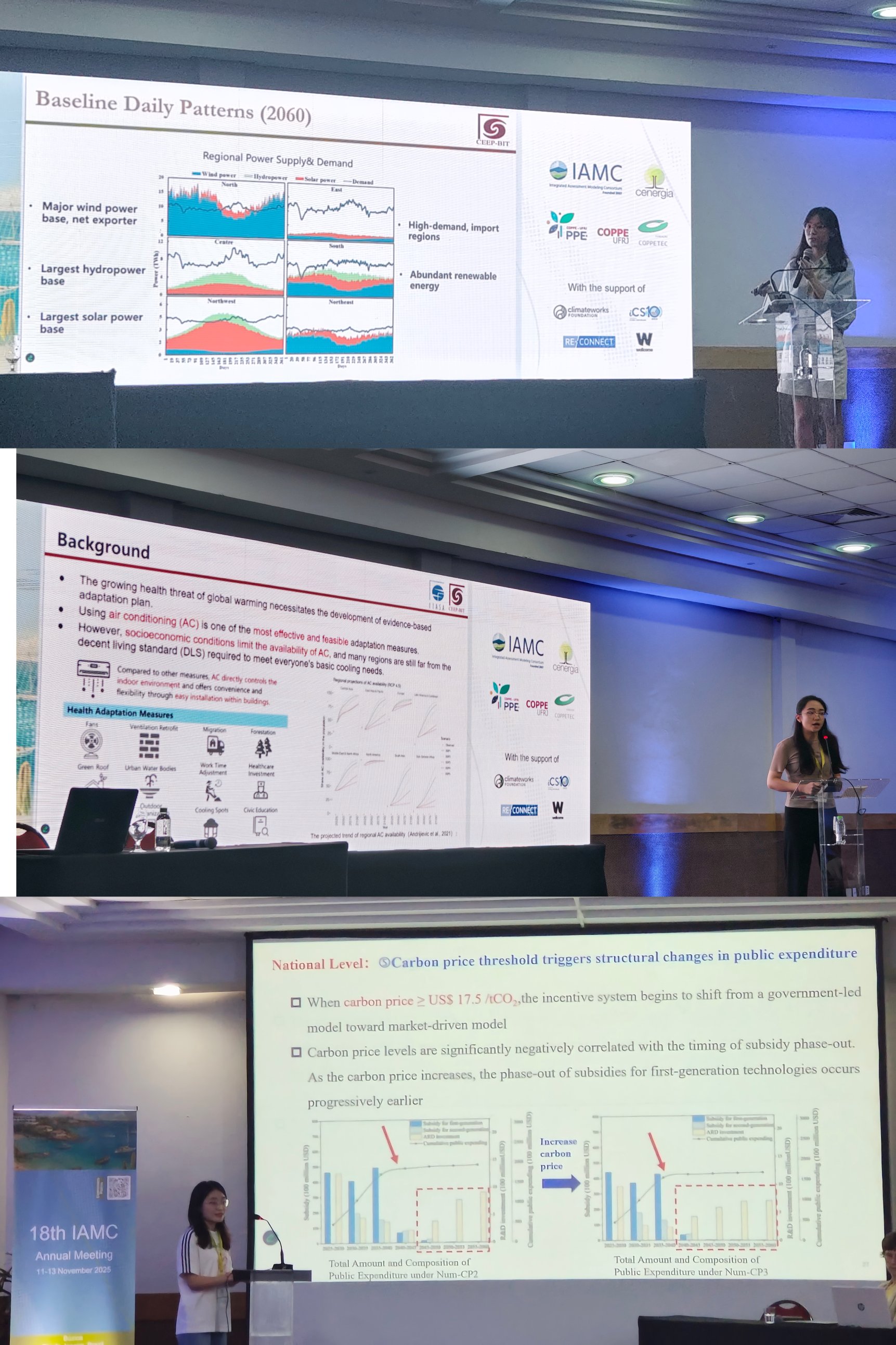
On‑site Presentation
This meeting has furnished valuable experience for the CEEP‑BIT team to advance and innovate follow‑up research. In subsequent sessions, doctoral candidates Wang Hao and Hu Yuxiang will give an oral presentation and a poster display respectively.
