


Belém time, November 18, 2025 marked the eighth official day of COP30. Delegates from the Center for Energy and Environmental Policy Research (CEEP-BIT) / Beijing Lab for System Engineering of Carbon Neutrality, Beijing Institute of Technology, participated in-depth in more than ten Pavilion events hosted by UN agencies, national pavilions, enterprise alliances, city alliances and academic think tanks throughout the day. They held in-depth dialogues with representatives from governments, research institutions, the financial sector and industries, and systematically tracked the latest developments in emission reduction, adaptation, finance, technological transformation and other areas on that day. Based on first-hand information from pavilions and side events, they sorted out and analyzed the key concerns and highlighted topics of the day at COP.
## Concern 1: Methane Governance and Reduction of Other Super Pollutants Accelerate in an All-Round Way
At today’s sessions, methane and black carbon governance were elevated to an unprecedented priority. The Global Methane Hub, together with the Australian Pavilion, launched the Methane Emergency Brake financing initiative and unveiled rapid emission reduction plans for the oil and gas sector in 10 pilot countries. The CCAC and Clean Air Fund jointly released the pocket card *Global Methane and Black Carbon Status Snapshot* for negotiators to carry for reference. At the Mobility & Transport Investment Corner, the World Business Council for Sustainable Development (WBCSD) facilitated on-site matchmaking between 15 multinational enterprises and transport authorities of 6 countries on green port and zero-emission truck fleet projects, further strengthening large-scale governance of short-lived air pollutants. Overall, multiple stakeholders are driving methane and other super pollutant governance from initiatives to concrete implementation through a combination of financing, standards, monitoring technologies and local actions.
## Concern 2: Accelerated Net-Zero Transition and Collective Upgrading of Industrial Technology Roadmaps
Net-zero roadmaps and energy system transformation became the second core theme of the day. The IEA updated its Global Energy-related Emissions Flash Report on a daily basis and opened the API of the *2025 Net Zero Tracker*, providing a more transparent data system for climate governance. UN agencies and the industry jointly emphasized that the pace of cross-sectoral and cross-regional energy system transition must be significantly accelerated. The IAEA’s Atoms for Climate Pavilion demonstrated the multi-sector contributions of nuclear technology to net zero, exemplified by small modular reactor demonstrations, nuclear hydrogen production and irradiated agriculture. IRENA, together with Chinese think tanks, released the latest global map of wind and solar power generation costs, highlighting a new round of national competition amid energy structure adjustment. The enterprise alliance released the updated *CTAP 2025* at the Business Pavilion to guide multinational enterprises in accelerating supply chain decarbonization. It is evident that net-zero targets are being materialized and institutionalized through technology roadmaps, real-time emission data, regional cost curves and corporate action standards.

CEEP delegates hold in-depth exchanges with Brazilian delegates at the plenary hall
## Concern 3: Restructuring of the Climate Finance System and Deepened Connectivity of North-South Cooperation Mechanisms
The accessibility and implementability of climate finance became the third major focus. Four major fund institutions, namely GEF, GCF, AF and CIF, jointly launched the One-Stop Project Preparation Window and the *2025 Climate Finance Synergy Guide* at the Climate Funds Pavilion, to reduce institutional frictions and improve financing efficiency for developing countries. UNEP led the release of the *Regional Plastic Reduction Financing Roadmap* and coastal wetland blue carbon methodologies, strengthening the financing bridge for coastal zone and plastic governance. The Brazil Pavilion launched the Amazon bio-value chain project financing platform through instant matchmaking events involving 60 enterprises. The Brazil-EU Climate Center and Regions4 co-hosted the roundtable Turning Cooperation into Local Action and launched the Just Resilience Action Platform to help local governments improve their capacity to access funds. Climate finance presented a trend of rapid linkage across multiple mechanisms, regions and stakeholders on that day, providing new institutional innovation samples for the expansion of global investment after 2025.
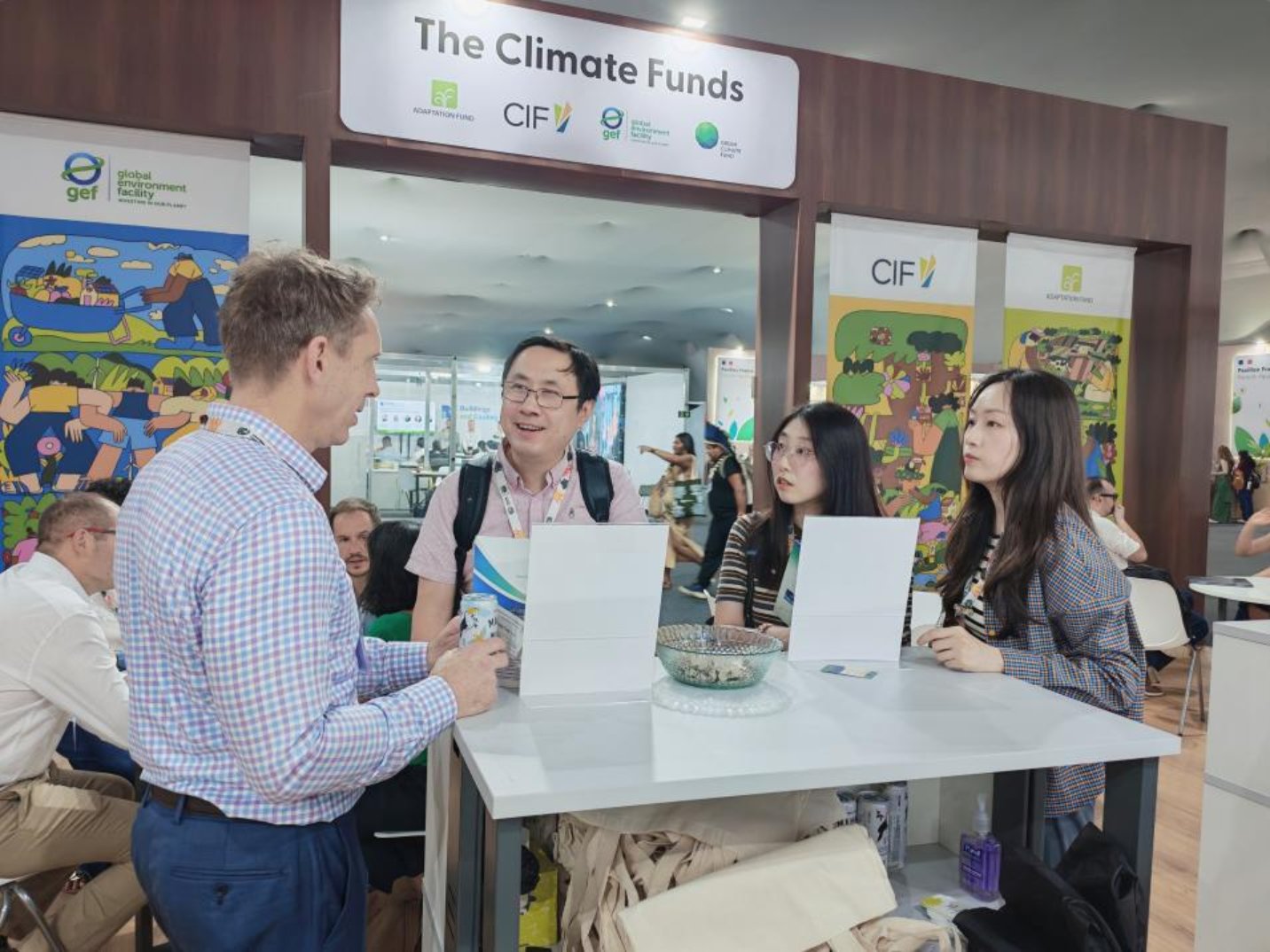
CEEP delegates exchange views at the Climate Funds Pavilion
## Concern 4: Accelerated Integration of Adaptation and Nature-Based Solutions Under Multi-Level Governance
Various pavilions sent a clear signal collectively today: governance networks from international to sub-national levels are accelerating the integration of nature-based solutions (NbS) and adaptation actions. UNESCO and the Ocean Pavilion released the cryosphere-sea level rise early warning system and marine education interactive content, providing advance climate risk information for coastal and island countries. At the Forest Pavilion, the ISC led the release of the *Primary Forest Disappearance Rate Tracker* and the conservation financing instrument led by the IPLC, strengthening the leading role of indigenous peoples in nature conservation. The Nature Pavilion released *RegionsAdapt 2025*, calling for increased sub-national adaptation funds, while the Climate Group coordinated 20 states/provinces to sign the Belém Electrification Declaration, enabling synergy between adaptation and emission reduction actions through electrification as a bridge. The America Is All In climate alliance updated municipal and state-level commitments, and 8 states including California announced the 2030 Nature Positive Statement, further establishing the backbone position of nature-based solutions in climate strategies at all levels of government. It can be seen that the multi-stakeholder linkage of nature – cities – communities – enterprises is forming a closed loop from science to governance, providing a new governance framework for future climate adaptation pathways.

CEEP delegates interact and exchange views on a green future at multiple national pavilions
## Outlook
As the ministerial segment approaches, the eighth day of COP30 has injected new momentum into global climate governance. Moving forward, financial commitments, carbon market schemes and emerging technologies will become the focus. All parties will conduct intensive consultations on the 2035 collective emission reduction target, the Global Goal on Adaptation (GGA) and the new collective quantified goal on climate finance (NCQG).
