


The orderly expansion of China’s National Carbon Emissions Trading System (CN ETS) constitutes one of the core tasks for improving carbon‑pricing mechanisms and delivering the dual‑carbon goals. Focusing on carbon‑market expansion, Professor Wang Ke’s team from the Center has carried out systematic research on optimized sector‑inclusion sequencing and corporate emission‑entry‑threshold setting. From the perspective of abatement‑cost savings, the team proposes implementation pathways for carbon‑market expansion that balance abatement benefits, economic efficiency and corporate burdens. Relevant findings have been published successively in iScience and Fundamental Research.

I. Sector‑Expansion Scheme: Optimizing Sector Inclusion Sequence to Substantially Cut Society‑Wide Abatement Costs
Against increasingly urgent carbon‑reduction targets and the need for sectoral expansion of China’s national carbon market, the iScience‑published study draws on a micro‑database covering more than 2.1 million enterprises across over 500 four‑digit‑code industrial sectors. Incorporating sector‑heterogeneous abatement costs, it builds a firm‑level bottom‑up marginal abatement‑cost‑curve estimation model and puts forward an evaluation framework for sector‑priority sequencing centered on abatement‑cost savings.
Balancing sector priorities and market‑construction phases, the study conducts quantitative analysis on expansion scope and inclusion sequencing for 63 key sectors (13 planned sectors plus 50 high‑emission unplanned sectors). It generates a cost‑saving‑oriented priority‑expansion sector list and an optimized inclusion‑sequence scheme. Effectively reconciling macro abatement targets with micro‑level corporate cost‑benefit performance, this research provides scientific evidence for macro‑level planning of China’s national carbon market and for policy formulation in individual sub‑sectors.
Key analytical findings:
When only the 13 planned sectors are considered and ranked by abatement‑cost‑saving principles, cement manufacturing should be included right after the power‑generation sector, followed by iron‑and‑steel smelting.
A comparison between the baseline strategy (two‑phase assessment for the 13 planned sectors and the subsequent 50 expanding sectors) and the holistic strategy (unified ranking for all 63 sectors without pre‑assigned sector priorities) shows that under the holistic strategy, only cement manufacturing and non‑wood‑and‑bamboo pulp manufacturing among the 13 planned sectors make it into the top‑13 list for cost‑saving benefits.
If China’s national carbon market is limited solely to the 13 planned sectors, the cost‑reduction function of the ETS will be weakened. To achieve abatement volumes equivalent to those delivered by the baseline strategy covering the 13 planned sectors (236.3‑1094.7 MtCO₂), the holistic strategy would require 22‑43 included sectors, of which merely 4‑5 belong to the planned‑sector list.
In cost‑benefit terms, the average abatement cost under the holistic strategy is 39.5 %‑78.3 % lower than under the baseline strategy. Meanwhile, moderately lowering enterprise‑inclusion thresholds to bring in small‑and‑medium‑sized sectors under the holistic strategy could yield cumulative abatement‑cost savings of 2182.2‑9472.8 billion RMB, equivalent to 1.2 %‑5.0 % of China’s total industrial output value in 2011.

Sector‑expansion sequencing based on abatement‑cost savings
The study recommends establishing a sector‑expansion sequencing mechanism prioritizing marginal abatement‑cost savings and optimizing batch‑wise sector‑inclusion lists, so as to achieve full coverage of industrial sectors under China’s national carbon market at minimum economic cost.
II. Enterprise Entry Threshold: Scientifically Setting Inclusion Cut‑offs to Balance Abatement‑task Coverage, Compliance Costs and Regulatory Burden
Setting corporate emission‑entry thresholds is critical for carbon‑market expansion. Threshold levels directly determine the number of covered enterprises, abatement‑coverage scope, compliance burdens on small‑ and medium‑sized enterprises (SMEs), and Monitoring, Reporting and Verification (MRV) costs. Focusing on optimizing corporate emission‑entry thresholds for China’s national carbon market, the study published in Fundamental Research proposes a threshold‑optimization framework built upon marginal abatement‑cost curves. Targeting maximum unit abatement‑cost savings, it systematically characterizes gaps in abatement costs for enterprises under the carbon‑market regime versus command‑and‑control policies.
Key analytical findings:
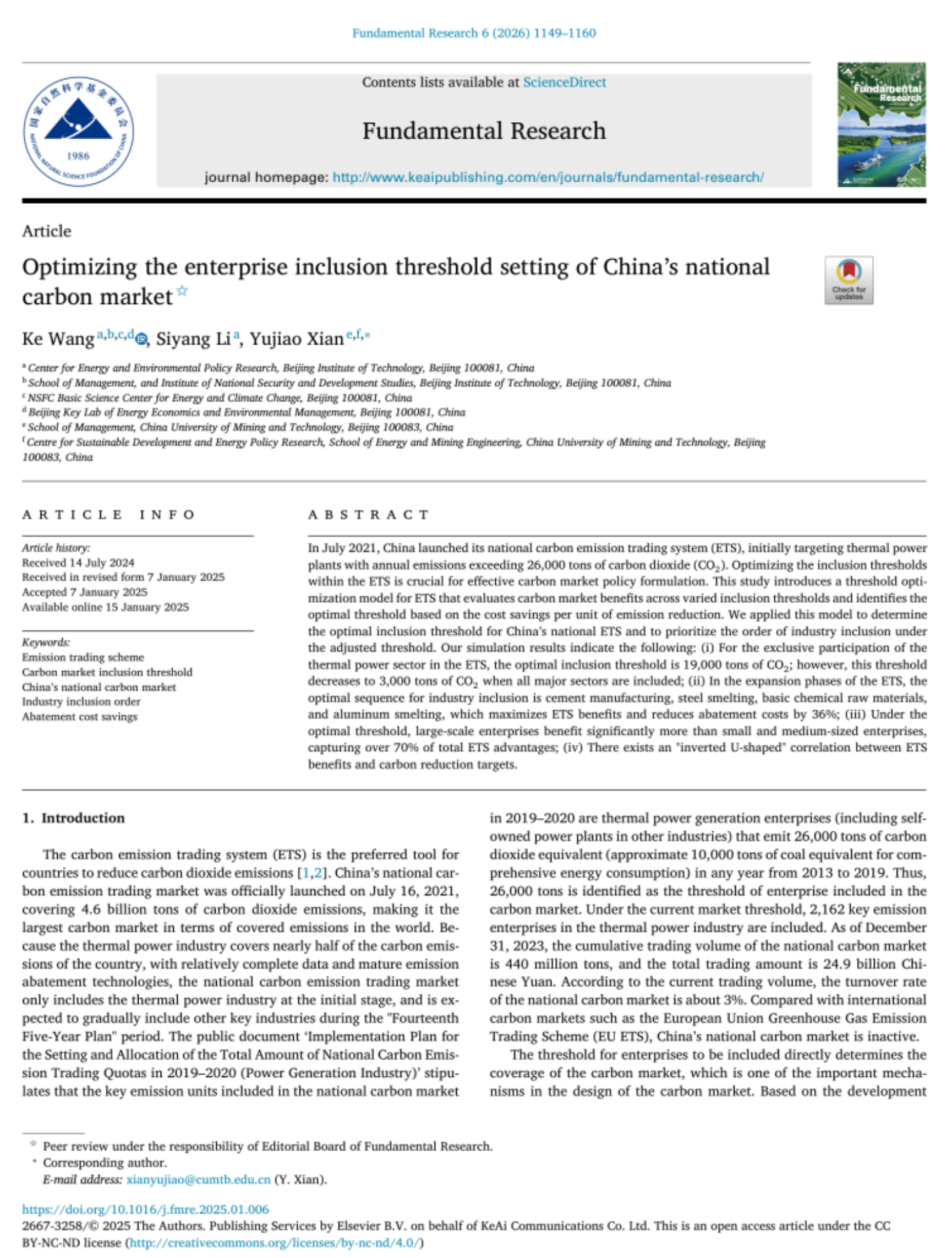
Under the baseline scenario with a 20 % abatement target: if the ETS covers only the thermal‑power sector, the optimal corporate emission inclusion threshold stands at 19 000 tons of CO₂, covering 60 % of sampled firms and delivering roughly 13 % in cost savings. When coverage extends to all seven key sectors, the optimal threshold drops to 3 000 tons of CO₂, cost savings rise to approximately 30 %, and allowance trading volume reaches 952 million tons.
Following the “include‑a‑sector‑once‑it‑is‑ready” principle for sectoral expansion, the study simulates 55 sector combinations and identifies the optimal inclusion order: cement manufacturing, iron‑and‑steel smelting, basic chemical‑raw‑material production, aluminium smelting, and so forth. This pathway maximizes carbon‑market gains and cuts abatement costs by around 36 % compared with random‑inclusion scenarios.
Carbon‑market returns exhibit an inverted‑U relationship with abatement targets: moderately raising abatement targets stimulates trading, while excessively stringent targets compress profit margins for enterprises. Under current allowance‑allocation rules, large enterprises capture over 70 % of total market gains at the optimal threshold, whereas SMEs risk incurring losses upon entering the market for compliance.
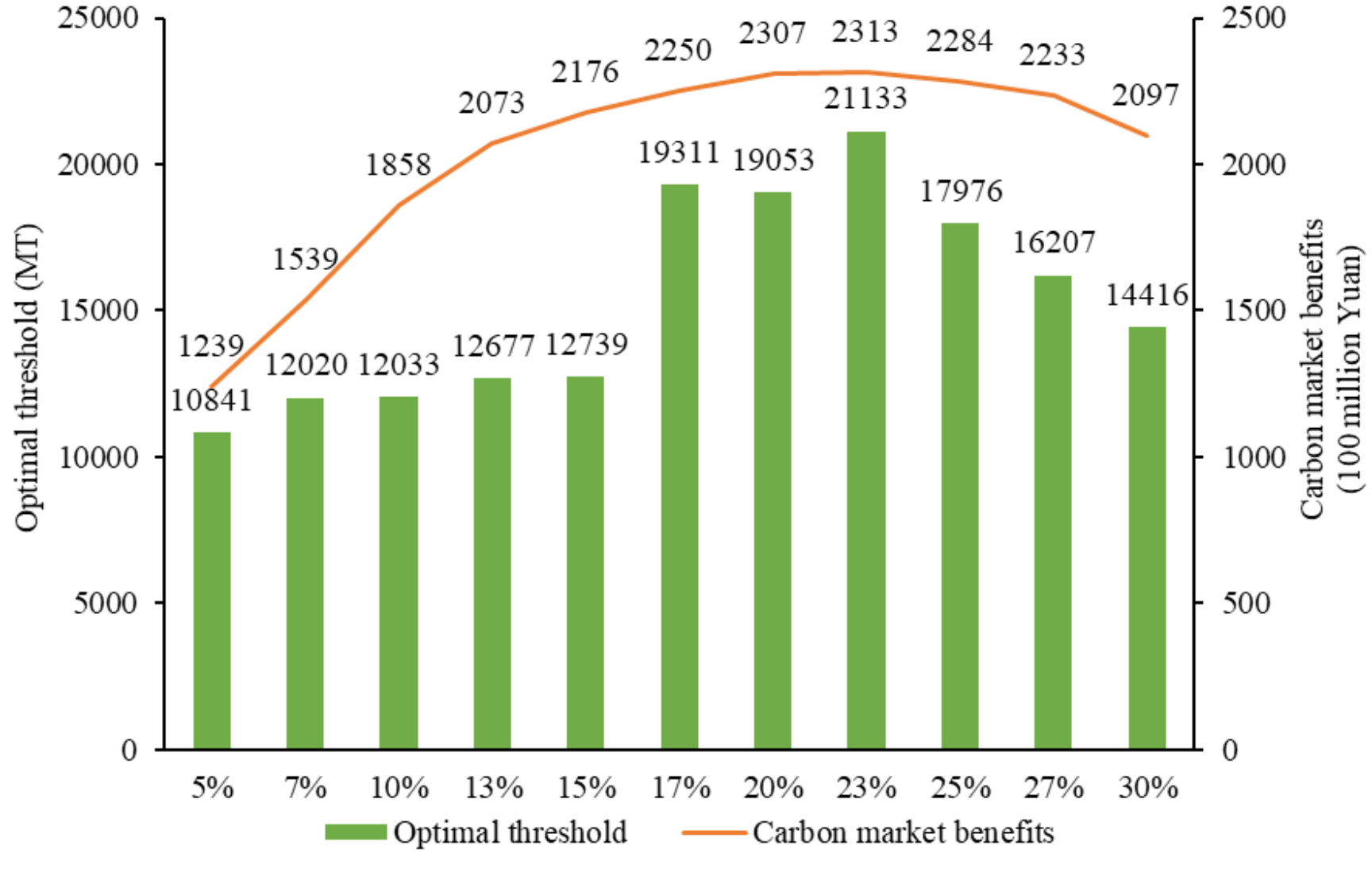
Optimal inclusion thresholds for thermal‑power enterprises and carbon‑market benefits under different abatement targets
The research suggests adopting differentiated sector‑specific entry thresholds, alongside simplified MRV accounting rules for micro‑enterprises and tiered allowance‑allocation systems. As China’s national carbon market matures, overall entry thresholds should be dynamically adjusted to realize phased full coverage of emitting entities.
The orderly expansion of China’s national carbon market represents one of the core tasks for carbon‑market system development over the coming decade. The Center will continue quantitative assessments on key expansion‑related issues including sector coverage, entry rules, allowance allocation and cross‑sector coordination, so as to provide scientific support and policy references for the phased, steady expansion and high‑quality operation of China’s national carbon market.
Paper details
Wang, K., Wang Z., Xian Y., Shi X., Yu J., Feng, K., Hubacek, K., Wei, Y. (2023). Optimizing the rolling out plan of China’s carbon market. iScience, 26(1), 105823. https://doi.org/10.1016/j.isci.2022.105823
Wang, K., Li, S., Xian, Y. (2026). Optimizing the enterprise inclusion threshold setting of China’s national carbon market. Fundamental Research, 6(2), 1149‑1160. https://doi.org/10.1016/j.fmre.2025.01.006
