


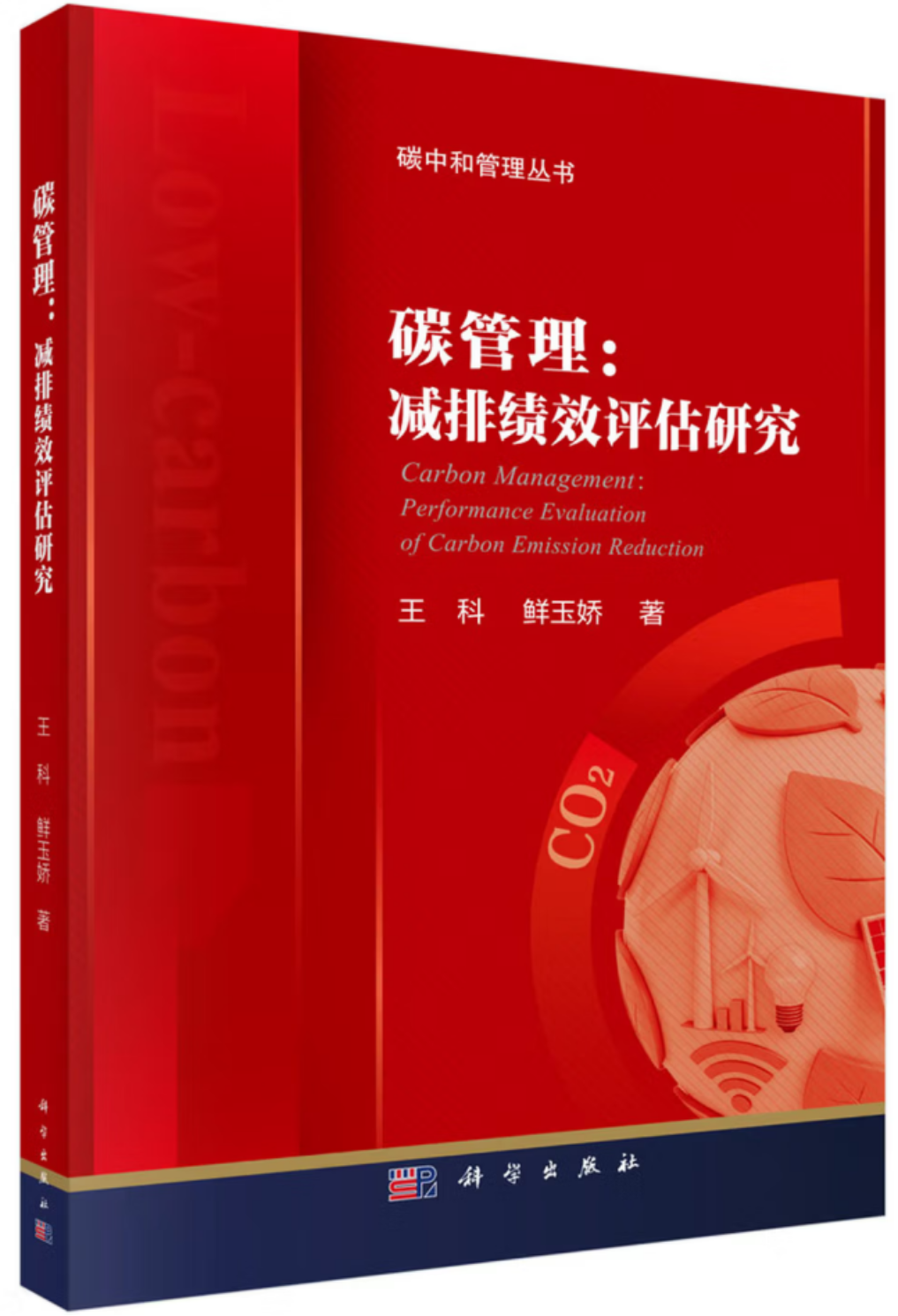
Recently, Carbon Management: Research on Emission‑Reduction Performance Evaluation, led by Professor Wang Ke from the Center for Energy and Environmental Policy Research at Beijing Institute of Technology, has been officially published by Science Press. This book represents one of the systematic summaries and serial outputs generated by Professor Wang Ke’s team based on long‑term research into major economic‑management issues under carbon neutrality.
Emission‑reduction performance offers a comprehensive measure of the low‑carbon development level and abatement outcomes of carbon‑emitting entities. With deepening global industrialization and rising total energy consumption, pressure for CO₂ mitigation keeps mounting. Tackling climate change and accelerating green‑low‑carbon transition have gained broad international consensus. Against this backdrop, as one of the world’s major energy consumers and carbon emitters, China’s energy‑structure optimization, control over carbon emission intensity and absolute emissions, and improvement of emission‑reduction performance bear significance not only for its own sustainable development but also exert decisive influences on delivering global climate‑governance goals. Scientifically and systematically identifying features of carbon emissions across the globe and within China, gaining in‑depth insight into the evolution of China’s carbon‑mitigation policies, and accurately evaluating emission‑reduction performance at regional, sectoral and firm levels constitute indispensable links in pursuing the dual‑carbon goals.
Professor Wang Ke’s team at the Center for Energy and Environmental Policy Research has long engaged in energy‑and‑climate‑economic modelling, conducting thorough, systematic investigations into theories, methodologies and practical issues concerning emission‑reduction‑performance evaluation. Centered on two core indicators — carbon productivity and marginal abatement cost of carbon, Carbon Management: Research on Emission‑Reduction Performance Evaluation establishes a systematic theoretical framework and methodological system for assessing carbon‑mitigation performance. The book contains eleven chapters in total. Chapter 1 sets out the research background of global climate governance and China’s role. Chapter 2 builds the core conceptual system and modelling foundations for emission‑reduction‑performance evaluation. Chapters 3‑6 carry out multi‑dimensional analyses of carbon‑productivity assessment. They put forward theories and methods for carbon‑productivity evaluation that account for disparities in energy and emission mix, differences in production and abatement technologies, combined economic‑environmental benefits, and constraints from markets and environmental capacity, with practical verification conducted for the thermal‑power and construction sectors. Chapters 7‑10 present multi‑faceted research on marginal carbon abatement costs. They propose estimation theories and methods for marginal abatement costs oriented toward combined production‑abatement strategies, for handling data‑ and environment‑related uncertainties, for constructing marginal abatement‑cost curves amid dynamically changing mitigation targets, and for identifying curve features via functional data analysis. Applications and validations are implemented in typical industries including iron‑and‑steel, petrochemicals, building materials, pulp‑and‑paper, and glass manufacturing. Chapter 11, rooted in China’s national realities, explores green‑low‑carbon transition pathways that balance development and emission reduction through continuous improvement of carbon‑mitigation performance. It summarizes practical experience and offers referable Chinese cases for global climate governance.
Delivering a scientifically sound, systematic and operable system for evaluating, analysing and managing carbon‑mitigation performance, this book provides solid decision‑making support for low‑carbon transitions in China and worldwide through innovative methodologies and abundant empirical studies. It can serve as teaching material for management‑ and economics‑related majors in universities, practical reference for researchers working on energy‑climate economics and carbon‑neutrality technology and management, as well as reading for relevant policymakers and administrators in government bodies and enterprises.
