


Recently, Wang Fangzhi, PhD graduate from the Center for Energy and Environmental Policy Research, together with his supervisor Professor Liao Hua and co‑authors, have endogenized economic structure within a cross‑system dynamic general‑equilibrium climate‑economy framework, and proposed and mathematically proven the theory of Baumol’s climate disease. This research deepens the understanding of the complex interactions among climate change, economic growth and economic structure, and extends the classic Baumol’s cost‑disease theory originally put forward in the 1960s by William J. Baumol, former President of the American Economic Association. The study consists mainly of three parts:
Cross‑system Climate‑economy Modelling:
Building upon Nordhaus’s one‑sector DICE model, a dynamic general‑equilibrium climate‑economy model with endogenously evolving economic structure is constructed. The model captures the dynamic adjustment of economic structure in response to climate change. It can be further extended to climate‑economy system models with alternative sectoral divisions, providing support for climate‑policy simulation and assessment.
Climate Damage Assessment:
Mathematical deductions reveal that heterogeneity in climate‑induced damages across sectors amplifies aggregate economic losses. Due to divergent climate vulnerability among sectors and limited substitutability of outputs, output prices of climate‑exposed sectors will rise in the future. This draws more capital and labour into these sectors, thereby increasing the overall economy’s vulnerability to climate change. This research introduces climate vulnerability into existing structural‑change literature as a key driver of sectoral relative‑price dynamics that shape economic transformation.
Economic‑structural Change and Climate Damages:
Further analysis explores how the interaction between technological‑progress rates and climate vulnerability shapes climate‑related losses. The results show that these two factors jointly determine sectoral relative prices and the magnitude of the cost‑disease effect. When sectors with rapid technological progress feature high climate vulnerability while sectors with slow progress are less vulnerable, total economic losses remain contained: rapid technological progress acts as enhanced climate resilience and enables speedy post‑shock recovery. Conversely, when sectors with slow technological progress bear higher climate vulnerability — such as construction, healthcare, and agriculture in less‑developed regions — their relative prices surge and exacerbate aggregate climate damages. This finding carries implications for climate‑adaptation policy: adaptation finance should be prioritized for sectors characterized by slow technological progress and high climate vulnerability, so as to strengthen their resilience and mitigate macroeconomic risks.
The paper was published online in European Economic Review on October 15. Wang Fangzhi, the first author, obtained his PhD degree from the Center for Energy and Environmental Policy Research in 2024, and this study forms part of his doctoral dissertation. The corresponding author is his supervisor Professor Liao Hua. Supported by projects of the National Natural Science Foundation of China and the Beijing Lab for System Engineering of Carbon Neutrality in recent years, the research team has been advancing theoretical and modelling work in climate economics by incorporating structural heterogeneity into cross‑system dynamic general‑equilibrium frameworks. Notable outputs have been achieved covering endogenous modelling of climate preferences and industrial structure, Pigouvian‑tax theory for cross‑regional and inter‑temporal coordinated mitigation of carbon and pollutant emissions, and the social‑cost‑of‑carbon theory.
Paper link: Wang, F., Liao, H., & Tol, R. S. (2025). Baumol's climate disease. European Economic Review, 105175. https://doi.org/10.1016/j.euroecorev.2025.105175
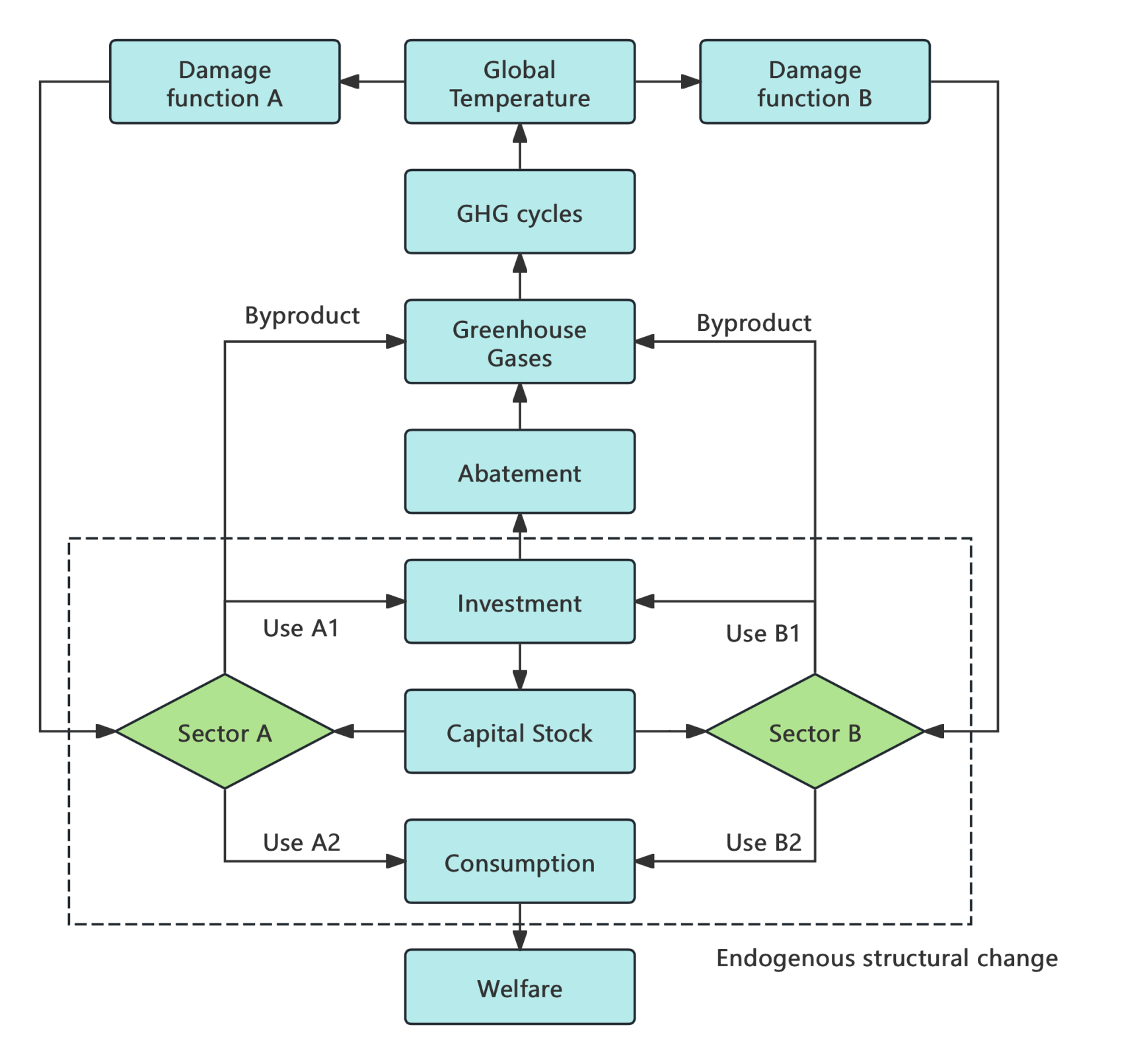
Figure: Framework of the dynamic general‑equilibrium climate‑economy model with endogenous economic structure
