


To promote academic exchanges and cooperation among experts and scholars in the field of energy economics and management and facilitate the cultivation of high-level talents, the 15th Annual Academic Conference on Energy Economics and Management in China & the 18th Strategic Seminar on Energy Resource Development and Utilization will be held in Dalian, Liaoning Province from September 4 to 6, 2026. Jointly sponsored by the Department of Management Sciences of the National Natural Science Foundation of China, the Energy Economics and Management Research Branch of Chinese Society of Systems Engineering, and Dalian University of Technology, and undertaken by the School of Economics and Management of Dalian University of Technology, this conference sincerely invites experts, scholars and graduate students in relevant fields to submit papers and attend the conference. Relevant arrangements are announced as follows:
I. Conference Theme
Global Energy Transformation and the Construction of a Powerful Energy Nation
II. Conference Arrangements
1. Academic Exchanges: Disciplinary development reports, special keynote reports, plenary speeches, Deans’ Forum, Roundtable Forum for Outstanding Young Talent Development, Academic Journal Editors Forum, and thematic parallel sessions. A dedicated session for basic research projects funded by the National Natural Science Foundation for young doctoral students will be set up, inviting principal investigators (doctoral students) of funded projects in the field of resource and environmental economics and management to present research progress reports.
2. Award Ceremony: Presentation of annual awards including the Energy and Climate Change Outstanding Contribution Award, Best Paper Award, Best Reviewer Award, and the Guoshun Outstanding Doctoral Dissertation Award (see Appendix 1 for application guidelines).
3. Pre-conference Workshop (September 3–4): Primarily oriented toward young teachers and graduate students. Invited experts and scholars will share insights on cutting-edge academic issues, interpret energy economic model methodologies, and present personal or team research experiences and project cases (see subsequent sections for consultation and registration methods).
4. Talent Recruitment: Doctoral recruitment by relevant universities and enterprises.
5. Academic Resource Exhibition: Display of high-quality domestic and international academic journals, professional books, Chinese and foreign literature databases and other academic resources.
III. Main Topics
Topics include but are not limited to: energy security, new energy system construction, energy market and industrial policies, energy conservation and emission reduction technology management, climate economics theories, climate-economic system modeling methods, climate engineering management, climate risk management, energy system optimization and decision-making, energy engineering management, energy transition and development, carbon peaking and carbon neutrality, green finance and carbon finance, carbon pricing mechanisms, global climate governance, green consumption and low-carbon behaviors, regional low-carbon transformation and collaborative governance, energy supply chain and operation management, corporate low-carbon operation and ESG, environmental regulation, etc.
IV. Organizing Institutions
Sponsors
Department of Management Sciences, National Natural Science Foundation of China
Energy Economics and Management Research Branch, Chinese Society of Systems Engineering
Dalian University of Technology
Undertakers
School of Economics and Management, Dalian University of Technology
Futures Research Institute, Dalian University of Technology
Co-organizers
Center for Energy and Environmental Policy Research, Beijing Institute of Technology
Beijing Laboratory for System Engineering of Carbon Neutrality
Basic Science Center Program of “Energy and Climate Change”, National Natural Science Foundation of China
MOE Joint International Research Laboratory of Carbon Neutrality System and Engineering Management
Editorial Department of Energy and Climate Change
Carbon Emission Reduction Engineering Management Professional Committee, China Coal Society
Chinese Society for Socio-Economic Systems Analysis
Beijing Operations Research Society
Complex System Professional Committee, Chinese Society of Systems Engineering
School of Management, Beijing Institute of Technology
Shandong Guoshun Construction Group Co., Ltd.
Previous Undertakers
Nanjing University of Aeronautics and Astronautics (2007), Xi’an University of Science and Technology (2008), China University of Mining and Technology (2009), Beijing Institute of Technology (2009), Shanxi University of Finance and Economics (2010), Beijing Institute of Technology (2010), Jiangsu University (2011), East China University of Science and Technology (2012), Wuhan University (2013), Beijing Institute of Technology (2014), Jinan University (2015), Nanjing University of Aeronautics and Astronautics (2016), Renmin University of China (2017), Central South University & Hunan University of Technology and Business (2018), East China University of Science and Technology (2019), Jiangsu University (2020), Yan’an University (2023), Guangxi University (2024), Xi’an Shiyou University (2025)
V. Conference Organizational Committee
Conference Chairs
Wei Yiming, Liu Zuoyi, Kang Xudong, Wu Gang
Conference Vice Chairs
Chen Bin |
Chen Shiyi |
Deng Xiangzheng |
Du Huibin |
Fan Tijun |
Fang Debin |
Jin Juliang |
Lei Yalin |
Liao Hua |
Liu Yu |
Lu Xi |
Ma Tieju |
Niu Dongxiao |
Tang Baojun |
Tian Lixin |
Wang Can |
Wang Zhaohua |
Wu Libo |
Yu Biying |
Zhang Jinsuo |
Zhang Lixiao |
Zhang Yuejun |
Zhou Dequn |
Zhou Peng |
Organizing Committee Chairs
Ye Xin (Dalian University of Technology), Liao Hua (Beijing Institute of Technology)
Organizing Committee Vice Chairs
Chen Weiqiang (Institute of Urban Environment, CAS), Wang Yudong (Nanjing University of Science and Technology)
Secretaries-General
Ma Xiaowei (Beijing Institute of Technology), Pan Xiongfeng (Dalian University of Technology), Ding Yongjian (Dalian University of Technology), Li Xianneng (Dalian University of Technology), Shang Hua (Dalian University of Technology), Chen Zhen (Dalian University of Technology)
VI. Supporting Journals
The conference accepts both Chinese and English manuscripts. With the authors’ consent, outstanding papers will be recommended to relevant supporting journals by research theme (journal list continuously updated):
Chinese Journals: Energy and Climate Change, Journal of Beijing Institute of Technology (Social Sciences Edition), Advances in Climate Change Research, Journal of China University of Geosciences (Social Sciences Edition), Chinese Journal of Population, Resources and Environment, Journal of Dalian University of Technology (Social Sciences Edition), Chinese Journal of Environmental Management, Coal Economic Research
English Journals: Energy and Climate Change, Advances in Climate Change Research, Chinese Journal of Population, Resources and Environment, Energy Policy, Resources, Conservation & Recycling, Resources, Conservation & Recycling Advances, Journal of Modelling in Management, Journal of Chinese Economic and Business Studies, Structural Change and Economic Dynamics
VII. Conference Venue
Nikko Hotel Dalian, Zhongshan District, Dalian, Liaoning Province (No. 123 Changjiang Road)
VIII. Key Conference Dates
August 16: Deadline for free submission of conference papers or abstracts (deadlines for thematic submissions are determined by session conveners)
August 20: Deadline for discounted conference registration fees
August 25: Hotel reservation deadline
September 3: On-site check-in for pre-conference workshop participants
September 3–4: Pre-conference workshop sessions
September 4: On-site check-in for conference participants
September 4: Extended Council Meeting of Energy Economics Branch (21:00–22:00)
September 5–6: Official conference sessions
September 7: Participant departure
IX. Conference Agenda
1. Disciplinary Development Report
Topic: To be confirmed
Speaker: Wu Gang (Researcher & Deputy Director, Department of Management Sciences, National Natural Science Foundation of China)
2. Special Plenary Reports
(1) Topic: Reflections on Engineering Construction Management in the Intelligent Era
Speaker: Lu Chunfang (Member of Chinese Academy of Engineering, Former Vice Minister of Railways & Former Deputy General Manager of China Railway Corporation)
(2) Topic: Research on Collaborative Carbon and Pollution Reduction Paths in the Transportation Sector
Speaker: He Hong (Member of Chinese Academy of Engineering, Director of Institute of Urban Environment, CAS)
(3) Topic: Deficiencies in Scientific Understanding of Human Contribution to Global Warming
Speaker: Zhang Renhe (Member of Chinese Academy of Sciences, Former Vice President & Dean of School of Atmospheric Sciences, Fudan University)
3. Plenary Speeches
(1) Topic: Strategic Choices for Energy Structure Transformation and Smart Grid Development
Speaker: Sun Shifang (National High-level Talent Program Leading Talent, Vice President of China Institute of Development Strategy)
(2) Topic: Construction of China’s Life Cycle Assessment Data Infrastructure
Speaker: Xu Ming (National Overseas High-level Talent, Deputy Dean of School of Environment, Tsinghua University & Member of UNEP International Resource Panel)
(3) Topic: Practice and Application of Energy Economics in the Petroleum Market
Speaker: Wang Haibo (Senior Expert & Director of Petroleum Market Research Institute, CNPC Economics & Technology Research Institute)
(4) Topic: Strategic Critical Metal Demand and Safety Management for Low-Carbon Energy
Speaker: Chen Weiqiang (Distinguished Young Scholar of National Natural Science Foundation of China, Researcher of Institute of Urban Environment, CAS)
(5) Topic: Low-Carbon Transformation and Governance Innovation of Agri-Food Systems
Speaker: Xie Wei (Excellent Young Scholar of National Natural Science Foundation of China, Vice Dean of School of Rural Development, Peking University)
(6) Topic: Collaborative Scheduling and Smart Supervision of Environmental Infrastructure
Speaker: Song Jinbo (National High-level Talent Program Leading Talent, Professor of School of Economics and Management, Dalian University of Technology & Principal of the First Batch of MOE Philosophy and Social Science Innovation Team)
(7) Topic: Rising Climate Extremes Amplify Global Terrorism Risk
Speaker: Wang Yudong (Excellent Young Scholar of National Natural Science Foundation of China, Dean of School of Economics and Management, Nanjing University of Science and Technology)
(8) Topic: Economic and Emission Reduction Benefits of Photovoltaic Recycling Models
Speaker: Li Jiashuo (Excellent Young Scholar of National Natural Science Foundation of China, Professor of Institute of Frontier and Interdisciplinary Science, Shandong University)
4. Deans’ Forum
Tang Baojun (Dean, School of Management, Beijing Institute of Technology)
Zhang Yuejun (Party Secretary, School of Business Administration, Hunan University)
Wang Qunwei (Dean, School of Economics and Management, Nanjing University of Aeronautics and Astronautics)
Wang Yudong (Dean, School of Economics and Management, Nanjing University of Science and Technology)
Ye Xin (Dean, School of Economics and Management, Dalian University of Technology)
Wu Sanmang (Dean, School of Economics and Management, China University of Geosciences (Beijing))
Wang Jianliang (Dean, School of Economics and Management, China University of Petroleum (Beijing))
Bai Chunguang (Dean, School of Economics and Management, China University of Petroleum (East China)), etc.
5. Roundtable Forum for Outstanding Young Talent Development
Wang Hui (China University of Petroleum (East China), Excellent Young Scholar of NSFC)
Liu Mengdi (University of International Business and Economics, Excellent Young Scholar of NSFC)
Meng Fanxin (Beijing Normal University, Excellent Young Scholar of NSFC), etc.
6. Special Session for NSFC Basic Research Projects for Doctoral Students
Principal investigators (doctoral students) of funded projects in the field of resource and environmental economics and management are invited to present research progress and share research achievements.
7. Pre-conference Workshops (September 3–4)
Workshop 1: Analysis of China’s Carbon Peaking and Neutrality Policy Framework and Key Management Science Issues
Speaker: Fang Kai (Zhejiang University, National High-level Talent Program Leading Talent)
Workshop 2: High-Quality Academic Paper Writing and Academic Norms in Energy Economics and Environmental Policy
Speaker: Shao Shuai (Tongji University, National High-level Talent Program Leading Talent)
Workshop 3: Energy and Climate Economic Modeling: From Policies and Technologies to Practical Pathways
Speaker: Sun Chuanwang (Xiamen University, Cheung Kong Distinguished Professor of MOE)
Workshop 4: Application of Input-Output Analysis in Energy and Climate Economics
Speaker: Tan Xianchun (Institute of Science and Technology Policy and Management, CAS, Chief Expert of National Social Science Fund Major Project, Lead Author of IPCC AR6)
Workshop 5: Theoretical Development and Green Transformation Model Construction Methods in the Post-EKC Era
Speaker: Yang Mian (Wuhan University, National High-level Youth Talent)
Workshop 6: Evaluation Methods and Operation Management of Energy Technologies: From Theory to Practice
Speaker: Zhu Lei (Beijing Normal University, Excellent Young Scholar of NSFC)
8. Academic Journal Editors Forum
Wang Lulu (Editor-in-Chief, Energy and Climate Change), Liu Chengqing (Executive Deputy Editor-in-Chief, Chinese Journal of Population, Resources and Environment), Yu Shiwei (Editor-in-Chief & Deputy Director of Editorial Board, Journal of China University of Geosciences (Social Sciences Edition)), Song Xu (Editor-in-Chief, Chinese Journal of Environmental Management), Gao Shuren (Editor-in-Chief, Journal of Dalian University of Technology (Social Sciences Edition)), Sun Chuanwang (Associate Editor, Energy Economics), Chen Jing (Associate Editor, International Review of Economics & Finance), Li Qiuting (Topic Editor, Energy)
9. Thematic Parallel Sessions
Session 1: Energy Transition and Climate Governance in the AI EraConvener: Yang Mian (Wuhan University, National High-level Youth Talent)
Session 2: Low-Carbon Energy Transition and Regional High-Quality DevelopmentConvener: Liu Yu (Peking University, Distinguished Young Scholar of NSFC)
Session 3: Mechanism & Data-Driven Optimization Modeling and Application of Energy-Environment SystemsConvener: Zhang Qi (China University of Petroleum, National High-level Talent Program Leading Talent), Xie Wei (Peking University, Excellent Young Scholar of NSFC), Wang Ge (North China Electric Power University)
Session 4: Green Low-Carbon Transformation and Regional Coordinated DevelopmentConvener: Shao Shuai (Tongji University, National High-level Talent Program Leading Talent)
Session 5: Transition from Dual Control of Energy Consumption to Dual Control of Carbon Emissions: Opportunities and ChallengesConvener: Sun Chuanwang (Xiamen University, Cheung Kong Distinguished Professor of MOE)
Session 6: Technological Innovation and Industrial Integration in the Energy IndustryConvener: Zou Shaohui (Dean, School of Management, Xi’an University of Science and Technology)
Session 7: Energy Industrial Chain and Supply Chain ManagementConvener: Jiao Jianling (Hefei University of Technology)
Session 8: High-Quality Development of Energy Futures MarketConvener: Wang Chunqing (Dalian University of Technology), Shang Qin (Dalian University of Technology)
Session 9: Energy Transition and Risk ManagementConvener: Wang Qunwei (Nanjing University of Aeronautics and Astronautics, National High-level Talent Program Leading Talent)
Session 10: Collaborative Management of Energy Transition and Strategic Mineral ResourcesConvener: Chen Weiqiang (Institute of Urban Environment, CAS, Distinguished Young Scholar of NSFC), Jin Gui (China University of Geosciences (Wuhan), National High-level Youth Talent)
Session 11: Global Climate Governance and Sustainable Development Goals (SDGs)Convener: Li Jiashuo (Shandong University, Excellent Young Scholar of NSFC)
Session 12: Sustainable Finance, Investment and Behavior in the AI EraConvener: Chen Jing (Cardiff University, Associate Editor of International Review of Economics & Finance)
Session 13: Digital Transformation and Low-Carbon Pathways of Power SystemsConvener: Wu Libo (Fudan University, Distinguished Young Scholar of NSFC)
Session 14: Transformation Pathways and Policy Simulation of New Power Systems Under Carbon Budget ConstraintsConvener: Dai Hancheng (Peking University, Excellent Young Scholar of NSFC)
Session 15: New Energy Transformation Development and Mineral Resource Security GuaranteeConvener: Wu Sanmang (Dean, School of Economics and Management, China University of Geosciences (Beijing), New Century Excellent Talent of MOE)
Session 16: New Power Systems and Power MarketConvener: Zhang Xingping (North China Electric Power University, New Century Excellent Talent of MOE)
Session 17: Management Frontiers of New Energy System ConstructionConvener: Zhu Lei (Beijing Normal University, Excellent Young Scholar of NSFC)
Session 18: Construction of New Energy Systems (Papers will be selected for special issue publication in Journal of China University of Geosciences (Social Sciences Edition) after revision)Convener: Yu Shiwei (China University of Geosciences (Wuhan), Excellent Young Scholar of NSFC)
Session 19: Solar Geoengineering for Climate Tipping Point Risk MitigationConvener: Liao Hua (Beijing Institute of Technology, Distinguished Young Scholar of NSFC), Yan Aijun (Xi’an Thermal Power Research Institute, China Huaneng Group, Convener of ISO/TC156/WG17)
Session 20: Research Frontiers and Progress of Carbon Emission Reduction Behaviors in Addressing Climate ChangeConvener: Long Ruyin (Jiangnan University, Chief Expert of National Social Science Fund Major Project)
X. Conference Website and Registration
1. Official Conference Websites
http://cseem.bit.edu.cn/index.htm
https://sem.dlut.edu.cn/
2. Registration Deadline and Method
① Deadline: 12:00, September 5, 2026
② Registration Method: All participants shall fill in and submit the participation confirmation form via Wenjuanxing (web link or QR code). Registration link: https://v.wjx.cn/vm/eo33Y84.aspx
QR code:

XI. Paper Submission Requirements
Two types of submissions are accepted: (1) Open submissions by authors; (2) Invited submissions by the organizing committee or session conveners.
Three submission channels are available for all authors. Please select only one channel and avoid duplicate submissions.
Item |
Channel 1: Conference-only Submission |
Channel 2: Conference & Journal Joint Submission |
Channel 3: NSFC Doctoral Project Submission (Invitation-only) |
Submission Content |
Full papers and abstracts are accepted, both Chinese and English |
Only full original unpublished Chinese papers are accepted |
Full papers and abstracts are accepted, both Chinese and English |
Award Eligibility |
Not eligible for Outstanding Paper Award selection |
Conference Outstanding Papers are exclusively selected from this channel |
Not eligible for Outstanding Paper Award selection |
Publication Form |
Abstracts included in the conference proceedings manual |
Abstracts included in the conference proceedings manual; excellent papers will be fully published in Energy and Climate Change after peer review |
Abstracts included in the conference proceedings manual |
Additional Notes |
No impact on subsequent submissions to other conferences and journals |
If accepted by Energy and Climate Change, the first author will enjoy a free registration fee for the 16th Annual Academic Conference in the next year |
No impact on subsequent submissions to other conferences and journals |
1. Deadline for open submissions: August 16, 2026
2. Submission Method:
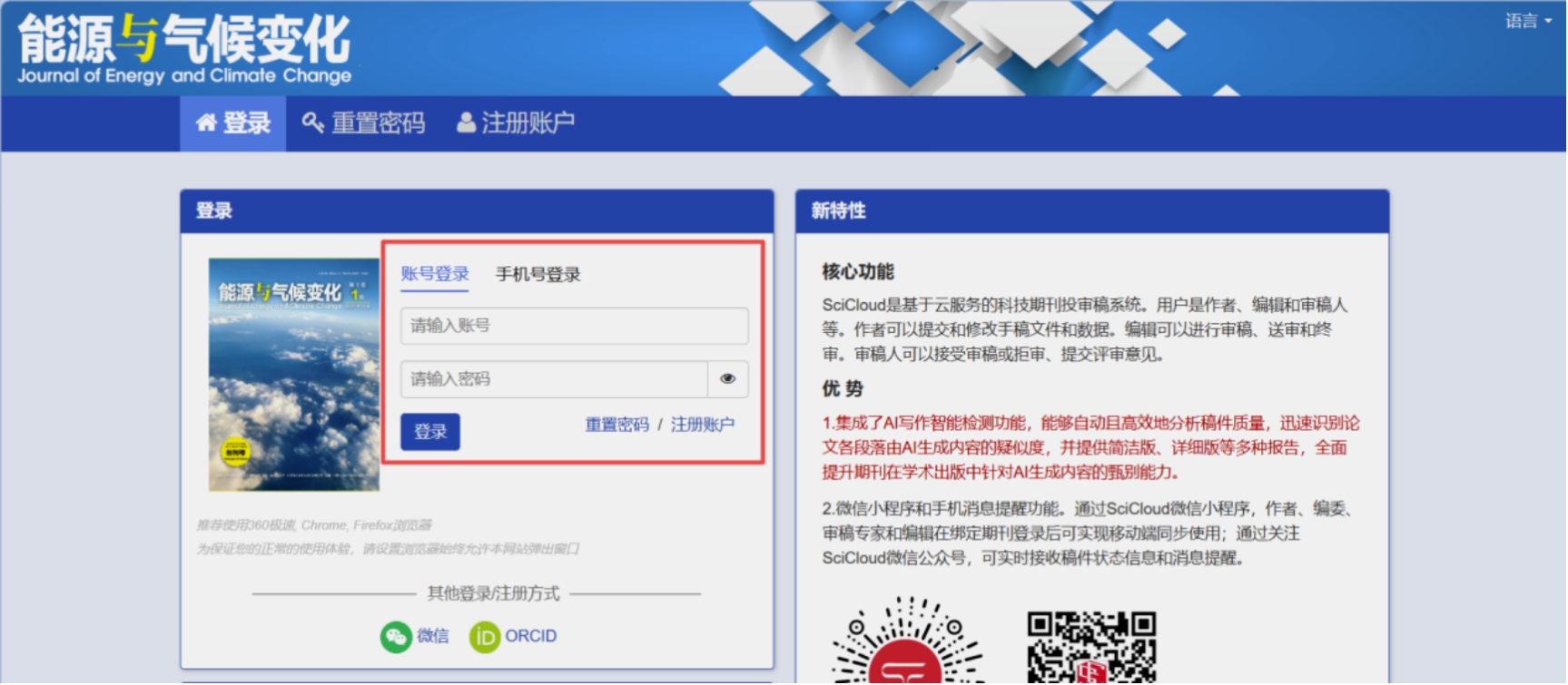
(1) Submit manuscripts via the peer review system of Energy and Climate Change (https://www.scicloudcenter.com/JECC) and select the corresponding submission topic:
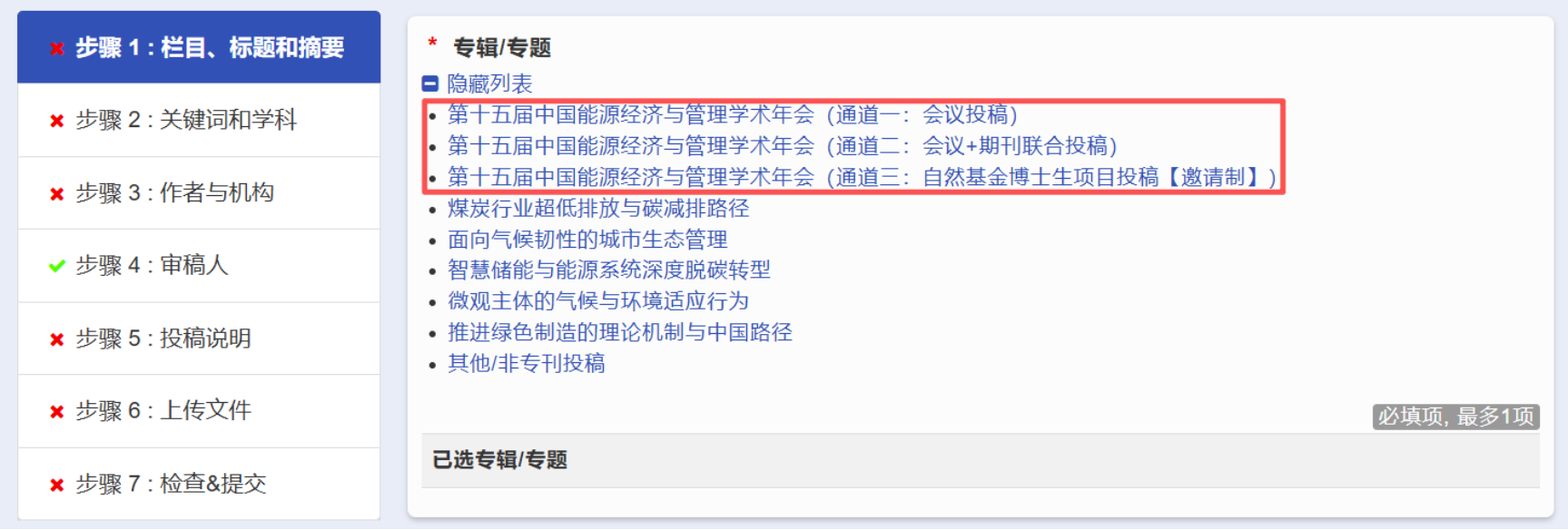
① Channel 1: Select “The 15th Annual Academic Conference on Energy Economics and Management in China (Channel 1: Conference-only Submission)”. Full papers or abstracts (abstract-only upload acceptable) in either Chinese or English are permitted. Fields without asterisks (*) can be left blank. This is a conference-only submission and will not affect other academic submissions.
② Channel 2: Select “The 15th Annual Academic Conference on Energy Economics and Management in China (Channel 2: Conference & Journal Joint Submission)”.
③ Channel 3: Select “The 15th Annual Academic Conference on Energy Economics and Management in China (Channel 3: NSFC Doctoral Project Submission (Invitation-only))”.
(2) Submit manuscripts in Word format in accordance with the author guidelines of Energy and Climate Change (https://www.sciengine.com/jecc/authorCenter?scroll=section_3).
(3) No revisions (including adjustments of author order and affiliations) will be accepted after submission. All manuscripts must clearly mark the names, affiliations and contact information of authors and presenters.

XII. Conference Fees
All participants shall pay conference registration fees. Accommodation and transportation fees are at participants’ own expense (the organizing committee can assist with hotel reservations).
1. Registration Fee Standards
Registration Type |
Before & On August 20Regular Participants (Postdocs included) |
Before & On August 20Students (with valid student ID) |
After August 20Regular Participants (Postdocs included) |
After August 20Students (with valid student ID) |
Energy Annual Conference Only |
CNY 1,800 |
CNY 1,200 |
CNY 2,200 |
CNY 1,500 |
Energy Annual Conference + Pre-conference Workshop |
CNY 2,200 |
CNY 1,500 |
CNY 2,800 |
CNY 2,000 |
2. Payment & Invoice Instructions (see Appendix 2 for detailed procedures)
(1) Bank Transfer: Pay via the official account of Dalian Shangge Impression Culture Media Co., Ltd. Remarks: “2026 Energy Annual Conference + (Workshop attendance if applicable) + Paying Unit + Payer” (abbreviation acceptable). Send the transfer voucher to the conference email: energy2025dlut@163.com.
(2) QR Code Payment: Pay via the dedicated QR code of Dalian Shangge Impression Culture Media Co., Ltd. with the same payment remarks as above.
(3) On-site Payment: Bank card, WeChat, Alipay and cash payments are acceptable during on-site registration.
(4) Invoice Issuance: Electronic invoices will be issued by Dalian Shangge Impression Culture Media Co., Ltd. Scan the dedicated QR code to fill in accurate information, and the invoice will be automatically sent to the reserved email address.
(5) Financial Contact: Pu Ling +86 15842421043
XIII. Accommodation Arrangements & Fees
1. Designated Conference Hotels & Agreed Prices
(1) Nikko Hotel Dalian
King Room: CNY 490/night (single breakfast)
Twin Room: CNY 490/night (single breakfast), CNY 570/night (double breakfast)
(2) Dalian Furong International Hotel (500 meters from the conference venue)
King Room: CNY 350/night (single/double breakfast included)
Twin Room: CNY 350/night (single/double breakfast included)
Hotel Reservation Contact: Xiu Yaning +86 15942893345
2. Hotel Reservation
Participants shall fill in room reservation information and select room types in the participation confirmation form. The organizing committee will assist with reservation arrangements.
3. Accommodation Payment & Invoicing
Accommodation fees shall be paid upon check-in, and invoices will be issued directly by the hotels.
XIV. Organizing Committee Contact Information
1. General Conference Inquiries
Shang Hua: +86 13478540166
Chen Zhen: +86 15998683937
WeChat Group Entry: Add WeChat IDs: greetsh, Dutchen, DK13009419150 (submit payment screenshot for group entry)
2. Pre-conference Workshop Inquiries
Zhang Guofeng: +86 13940806757, Email: zguofeng@dlut.edu.cn
WeChat Group Entry: Add WeChat ID: zhanggfdut (submit payment screenshot for group entry)
3. Talent Recruitment Session Inquiries
Zhang Lin: +86 18909863500, Email: zhanglin@dlut.edu.cn
4. Academic Resource Exhibition Inquiries
Dong Kun: +86 13009419150, Email: dongkun@dlut.edu.cn
XV. Transportation Routes to Conference Hotels
1. Nikko Hotel Dalian (Conference Venue)
Address: No. 123 Changjiang Road, Zhongshan District, Dalian
Transportation:
(1) Dalian Zhoushuizi International Airport
Route 1: 13 km away, 22-minute taxi ride, approximately CNY 30
Route 2: Take Metro Line 2 to Zhongshan Square Station (Exit D), then walk 10 minutes to the hotel
(2) Dalian Railway Station
Route 1: 1.8 km away, 10-minute taxi ride, approximately CNY 10
Route 2: 1.8 km away, 20-minute walking distance
(3) Dalian North Railway Station
Route 1: 18 km away, 24-minute taxi ride, approximately CNY 35
Route 2: Take Metro Line 2 to Zhongshan Square Station (Exit D), then walk 10 minutes to the hotel
2. Dalian Furong International Hotel (Accommodation Only)
Address: No. 19 Tuanjie Street, Xigang District, Dalian (Entrance of Russian Style Street)
Transportation:
(1) Dalian Zhoushuizi International Airport
Route 1: 12 km away, 20-minute taxi ride, approximately CNY 22
Route 2: Take Metro Line 2 to Zhongshan Square Station (Exit D), then walk 15 minutes to the hotel
(2) Dalian Railway Station
Route 1: 2.6 km away, 10-minute taxi ride, approximately CNY 10
Route 2: 0.7 km away, 10-minute walking distance
(3) Dalian North Railway Station
Route 1: 16 km away, 18-minute taxi ride, approximately CNY 20
Route 2: Take Metro Line 2 to Zhongshan Square Station (Exit D), then walk 15 minutes to the hotel
