


Wang Ke, Cong Ronggang, Kang Jianing, Yang Tingru and Zhang Tong from the Center for Energy and Environmental Policy Research (CEEP-BIT) / Beijing Lab for System Engineering of Carbon Neutrality, Beijing Institute of Technology, attended the 30th United Nations Climate Change Conference (COP30) in Belém, Brazil, and sent back the latest updates from the conference site.
November 17 was a day with a highly packed schedule and highly diverse themes in the COP30 side event agenda. More than 50 parallel side events were held on that day, covering four major sections: Adaptation and Loss & Damage, Mitigation, Means of Implementation, and Integrated Pathways, as well as a wide range of cross-cutting issues. The key highlights can be summarized into the following six aspects.
(1) Adaptation and Loss & Damage
Key concerns include: ① The "last mile" problem of finance: how to ensure vulnerable countries and communities can actually access adaptation and loss & damage funds without being held back by cumbersome procedures; ② How to quantify non-economic losses (cultural, health, migration, etc.) and integrate them into national adaptation plans and compensation mechanisms; ③ The skill-migration-adaptation triple chain issue: how to support mutual recognition of qualifications, scholarships and remittance reinvestment to turn "brain drain" into "green skill circulation"; and the health data gap issue, where insufficient data in low- and middle-income countries leads to systematic underestimation of climate-health impacts.
(2) Mitigation and Energy Decarbonization
Key concerns include: ① The role of "negative carbon" options within the 1.5°C pathway: nuclear power, hydropower, and biomass with CCS are back on the agenda, while "completeness of carbon accounting" becomes the focal point; ② Carbon market integrity: the High-Integrity Carbon Credit Sharing Principles led by the EU, Singapore and Kenya were officially unveiled, seeking to pave the way for global rules under Article 6 of the Paris Agreement; ③ Controversial mitigation issues related to hydropower, biomass and carbon removal: how to account for methane emissions, community relocation and biodiversity costs; ④ The 2030 global tripling renewable capacity target: Arab states, Latin American countries and ASEAN have respectively put forward regional financing and grid bottleneck solutions.
(3) Finance and Means of Implementation
Key concerns include: ① The "structural gap" in finance: what vulnerable countries lack most is not money, but absorptive capacity and risk mitigation tools; ② The triple crisis of sovereign debt, nature and climate: the UN Economic Commission for Latin America and the Caribbean, the United Nations Conference on Trade and Development, and the finance ministries of the UK and Germany have jointly promoted the "debt-for-nature + adaptation" hybrid instrument, but commercial creditors show low willingness to participate; ③ Data transparency: the International Organization for Standardization, the World Resources Institute and other bodies have jointly called for open data infrastructure to address the lack of credible baselines for both the global stocktake and CBAM; ④ Inclusion of smallholders and indigenous peoples in finance governance, involving three reform measures: board seat quotas, simplified eligibility thresholds and direct disbursement.
(4) Nature-based Solutions and Land
Key concerns include: ① Fragmentation of high-integrity standards: mutual recognition has not yet been reached among voluntary mitigation standard bodies such as Verra, Gold Standard, the Integrity Council for the Voluntary Carbon Market (ICVCM), and China's carbon sink standards (including methodologies for CCER forestry carbon sink projects, carbon sink afforestation and forest management projects, etc.), leading to high risk of double counting; ② Community rights issues: lack of land tenure confirmation, free, prior and informed consent (FPIC), and benefit-sharing mechanisms for nature-based solution projects; ③ Unclear monetization pathways for non-CO₂ benefits (biodiversity, water, livelihoods), which hinders blended finance.
(5) Cities-Infrastructure-Resilience
Key concerns include: ① Disconnection between city-level National Adaptation Plans (NAP) and Nationally Determined Contributions (NDC): national-level targets lack disaggregated indicators, making it impossible for cities to directly access international funds; ② Lock-in effect of buildings, transport and water systems: if new infrastructure built between 2025 and 2030 is not designed for the 1.5°C target, future retrofitting costs will double; ③ Triple mainstreaming of gender, disability and climate: three indicators of universal design, low-emission transport and green public spaces are to be included in the next review of the Paris Rulebook.
(6) Technology-Data-Transparency
Key concerns include: ① The "last mile" problem of measurement, reporting and verification (MRV) in developing countries: it is not a lack of methodologies, but a lack of sustained staffing, budgets and laboratories; ② Ethics of AI and emissions data: ownership of satellite and ground sensor data, and algorithmic bias may amplify distrust between the Global North and Global South; ③ Regional transparency hub model, involving mechanisms of shared laboratories, rotating regional scholars and open source code, which is expected to cover all Group of 77 countries by 2025.
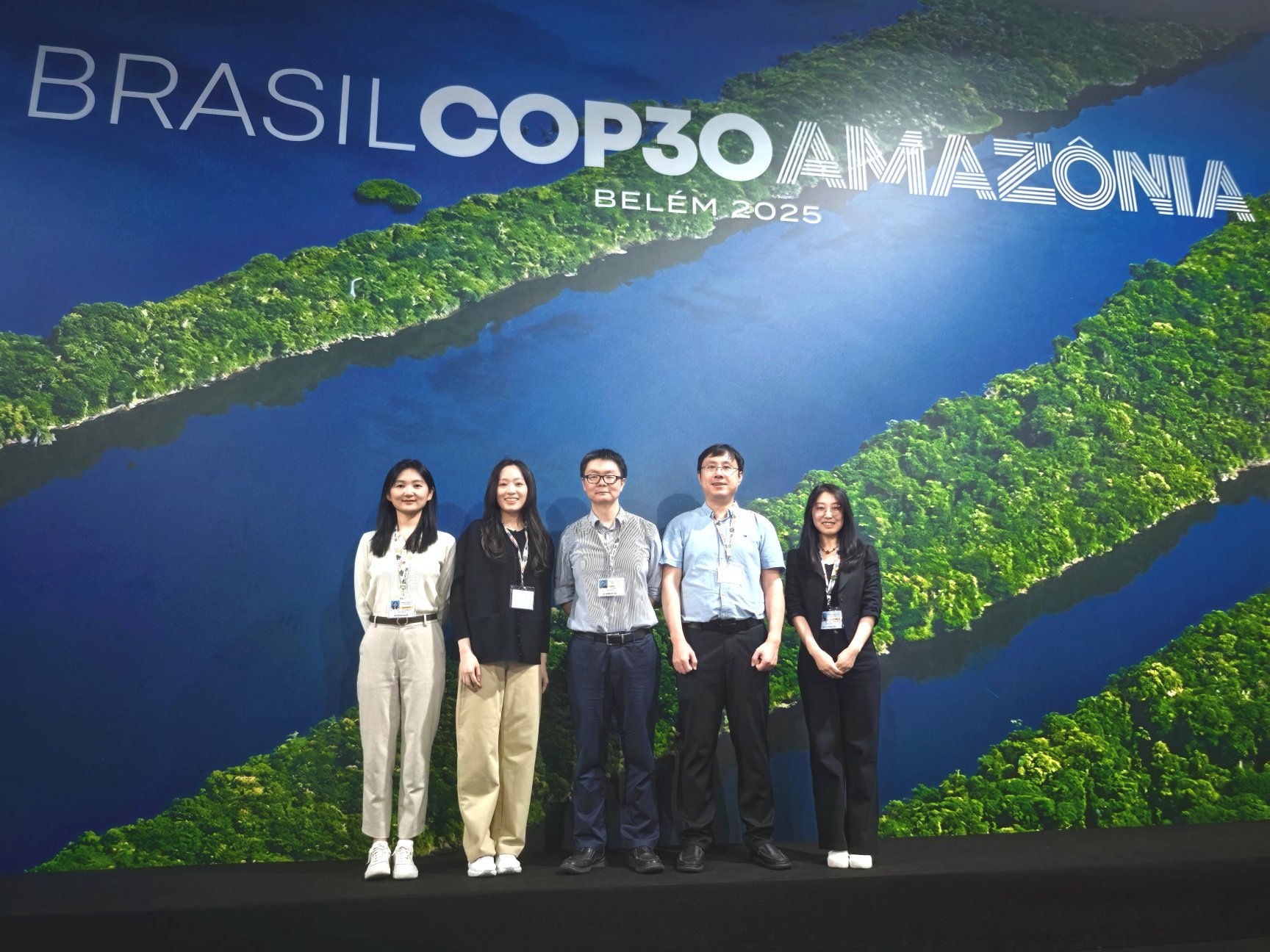
CEEP delegates at the conference theme wall
Report on Participation in the Side Event "Unlocking Climate Finance: From the Baku to Belém Roadmap to Systems Transformation"
All five CEEP delegates participated in-depth in the side event "Unlocking Climate Finance: From the Baku to Belém Roadmap to Systems Transformation" held on that day. At the event, the Making Finance Work for Climate Alliance (MFW4C), which represents 40% of global financial assets and brings together more than 500 public development banks from developed and emerging markets, put forward a systemic transformation financing framework, providing an operational roadmap for launching the new global climate finance architecture.
The Chair of the Alliance and Chief Executive Officer of the French Development Agency (AFD) noted that while climate finance from multilateral development banks reached a record 137 billion US dollars in 2024, only about 17% of the 1.9 trillion US dollars of global capital flows in 2023 went to emerging market and developing economies (EMDEs) excluding China, with only 46 billion US dollars allocated to adaptation finance. Systemic transformation remains stuck. He particularly emphasized that since the launch of the Baku Roadmap at COP29, more than 500 member institutions of the Alliance have reached a consensus: the rule design shifting from quantitative growth to qualitative leap must be completed at COP30.
The conference put forward five core connotations of climate system transformation finance: addressing structural barriers directly; simultaneously leveraging policy, market, institutional and behavioral levers; moving beyond individual projects to advance low-carbon and resilient upgrading of the entire economic system; taking countries as the main body and aligning with the Paris Agreement; and scaling up mitigation and adaptation finance. Meanwhile, key actions for the next phase were proposed: (1) Launch a global dialogue on transformation finance to form shared definitions and principles within the G7, G20 and COP30; (2) Integrate transformation indicators into climate finance statistics, information disclosure and risk management standards; (3) Leverage the 2.5 trillion US dollars per year public development bank network to deliver transformation in the climate finance system.
The German Federal Ministry for Economic Cooperation and Development, Brazilian Ministry of Finance, the United Nations Environment Programme (UNEP), African Development Bank, World Bank and 30 global asset management institutions attended the event, striving to make systemic transformation the core concept for unlocking the new global financial architecture, and opening up predictable, affordable and sustainable climate finance for emerging markets and developing countries.

CEEP delegates at the side event venue
Report on Participation in the Side Event "One UN for Multi-level Climate Action: Unlocking Finance and Implementation for NDCs and NAPs"
All five CEEP delegates participated in-depth in the side event "One UN for Multi-level Climate Action: Unlocking Finance and Implementation for NDCs and NAPs" held on that day. Hosted by the United Nations University (UNU), the event was co-organized by UN-Habitat, UNDP, UNCDF, UNFCCC, UNEP, UNDRR and WHO. It focused on the critical transition from climate needs to finance flow, and explored how to achieve coordinated advancement of NDCs and NAPs through multi-level governance, supported by institutional coordination and centered on financial supply, to accelerate climate action from planning to tangible impact.
Discussions unfolded in three in-depth rounds: The first round went straight to the core, exploring major gaps and opportunities in the transition from climate needs to finance flow, and seeking the linkage between financing mechanism optimization and policy implementation. The second round emphasized the implementation hub role of subnational governments, showcasing comprehensive solutions of NDC 3.0 in areas such as resilience building, housing security, health protection and equity and inclusion, and how they build practical carriers for capital to flow precisely to climate need scenarios. The third round looked ahead to the future, focusing on innovative pathways to unlock efficient capital flows and expand the effectiveness of climate action, and promoting deep alignment between financing models and implementation needs.
Delegates from multiple countries shared practical cases such as climate risk insurance, urban resilience building, cross-sectoral collaborative governance and locally led projects, presenting replicable and scalable experience from identifying climate needs to unlocking finance flows. This side event closely echoed COP30's concerns for the Global South, and emphasized that only by adhering to the principle of inclusion and adapting to local conditions to achieve precise matching between climate action and financing needs, and allowing capital to truly flow to the areas where climate action is most urgent, can the global climate governance process be effectively advanced.

CEEP delegates at the plenary hall
