


Belém time, November 19, 2025 marked the ninth official day of COP30. Delegates from the Center for Energy and Environmental Policy Research / Beijing Lab for System Engineering of Carbon Neutrality at Beijing Institute of Technology continued to take part in events organized by various institutions, obtained first‑hand information and sorted out the themes of the day. Side events at COP30 on that day centered on Just Transition and Climate Resilience, with multi‑dimensional discussions around “leaving no one behind”. The topics covered the 100% renewable‑energy pathway for Africa, the renewable‑energy capacity‑doubling initiative for the Arab region, women‑ and indigenous‑led forest conservation and climate solutions, global peatland restoration, smallholder rubber net‑zero projects, agricultural adaptation financing amid disasters and conflicts, as well as blue‑economy transition experience from Latin‑American island states. Spanning energy, land, ocean, cities, finance and governance, these sessions highlighted the core consensus that the green transition must be fair, inclusive and locally rooted. The key points are summarized in the following four aspects.
1. Just Transition “Going Beyond Energy”
The Islamic Development Bank put forward the concept of just land transition, placing land, food and nature at the heart of the transition and stressing the tripartite balance among climate, nature and livelihoods.
Multiple African countries presented 100‑percent renewable‑energy models, proving that a fossil‑free future is technically and financially feasible, and called for the reallocation of global capital.
2. Women’s and Indigenous Peoples’ Leadership
The WECF Gender‑Just Climate Solutions Awards released 12 grassroots case studies, demonstrating that women‑driven mini‑photovoltaic projects, community‑managed forests and circular‑agriculture initiatives can leverage three times more social capital.
The Amazon Basin Alliance released a draft standard for direct financing to indigenous peoples, requiring carbon‑market and REDD+ projects to comply with the principle of Free, Prior and Informed Consent (FPIC) and establishing a co‑managed fund accounting for 30 % of revenues.
3. Dual Breakthroughs for Peatlands and Blue Carbon
The Global Peatland Breakthrough Initiative received endorsement from 18 countries. It targets the restoration of 500 000 km² of peatlands by 2030 to sequester 1.5 Gt CO₂‑eq, and has opened a USD 500‑million fast‑track window together with the Green Climate Fund (GCF).
Latin‑American and Caribbean island states launched the Digital Blue Carbon Platform, which for the first time incorporates seagrass beds, mangroves and salt marshes into sovereign‑bond baselines. A USD 1‑billion blue bond is scheduled for issuance in 2026.
4. Climate Finance in Conflict‑Affected Zones
ODI, UNHCR and ICRC jointly issued the Guidance on National Climate Finance in Conflict Contexts, allowing humanitarian channels and adaptation finance to operate in parallel. Yemen, Chad and Ukraine are selected as the first batch of pilot countries. The GCF Board intends to approve an emergency allocation of USD 120 million before the closing of COP30.
Meanwhile, discussions on the Carbon Border Adjustment Mechanism (CBAM) remained a hot‑button issue at COP30. Five intensive sessions were held on CBAM:
(1) At the EU Pavilion, Maroš Šefčovič, Vice‑President of the European Commission, stated that CBAM is not a tariff but a carbon‑price equalizer. For 2026‑2030, the EU will lower default emission factors to the 75th‑percentile level of EU installations to provide accessible benchmarks for exporters. Relevant Chinese reports note that while the EU has for the first time pledged to tighten default values, the magnitude of reduction falls short of the actual demands of the Group of 77, which will fail to win acceptance among developing countries.
(2) At the US Center for Clean Competition, Senator Chris Coons indicated that the forthcoming CCA‑2025 Bill in the United States will set an initial price of USD 55 per tonne, USD 20 lower than the EU CBAM. It allows full credit for verified foreign carbon prices without applying default values. The United States invited all APEC economies to negotiate a shared framework for mutual recognition of carbon credits. Relevant Chinese reports point out that the United States is promoting a “low‑threshold version of CBAM” at COP30 with the intention of undermining the EU’s leading role. Representatives from China and India did not attend the relevant discussions.
(3) At the joint press conference of BASIC plus the African Group, Ebrahim Patel, South Africa’s Minister of Trade, stated that CBAM could reduce the export value of African steel and aluminium products by 20 %. African countries therefore called for a five‑year grace period and a “development box” exemption to shield least‑developed countries from the tax. According to relevant Chinese reports, the EU verbally replied that the proposal “could be considered” without offering any timeline.
(4) For the first time, the side‑event statement by the Alliance of Small Island States (AOSIS) did not label CBAM as “trade protectionism”. Instead, it called for channelling 30 % of CBAM revenues into the Loss and Damage Fund. Relevant Chinese reports observe that the shift in stance among small‑island states has created rifts within the G77.
(5) The Chinese delegation issued a statement: “China does not oppose carbon‑border policies per se, but rejects unilateral approaches that disregard the principle of common but differentiated responsibilities. China puts forward three essential requirements: first, recognition of differentiated responsibilities for developing countries; second, the use of actual emission values rather than default values; third, revenues shall be returned to exporting countries for emission‑reduction purposes.”
Delegates from the Center for Energy and Environmental Policy Research / Beijing Lab for System Engineering of Carbon Neutrality also took an active part in the side event New political economy of climate‑and‑trade: carbon border policies & emissions, trade, and industry. Centering on carbon‑border policies, the side‑event explored the differential impacts of alternative policy designs on emission‑reduction outcomes, trade flows and industrial structures. Debates covered the latest modelling research, comparisons of carbon‑footprint accounting methodologies, and potential consequences of such mechanisms for exporting countries in the Global South. Analyses from Resources for the Future (RFF) provided key inputs to the discussions. RFF specialists pointed out methodological discrepancies between carbon accounting and greenhouse‑gas accounting, and highlighted the close link between carbon‑intensity metrics and climate‑trade policies. Multiple experts jointly appealed that against the backdrop of proliferating new carbon‑border mechanisms worldwide, interoperability among different systems should be strengthened to avoid fragmented rule‑making. In the meantime, debates over handling‑trade‑related climate measures within the broader framework of climate justice and multilateral cooperation intensified and constituted one major theme of this side event.
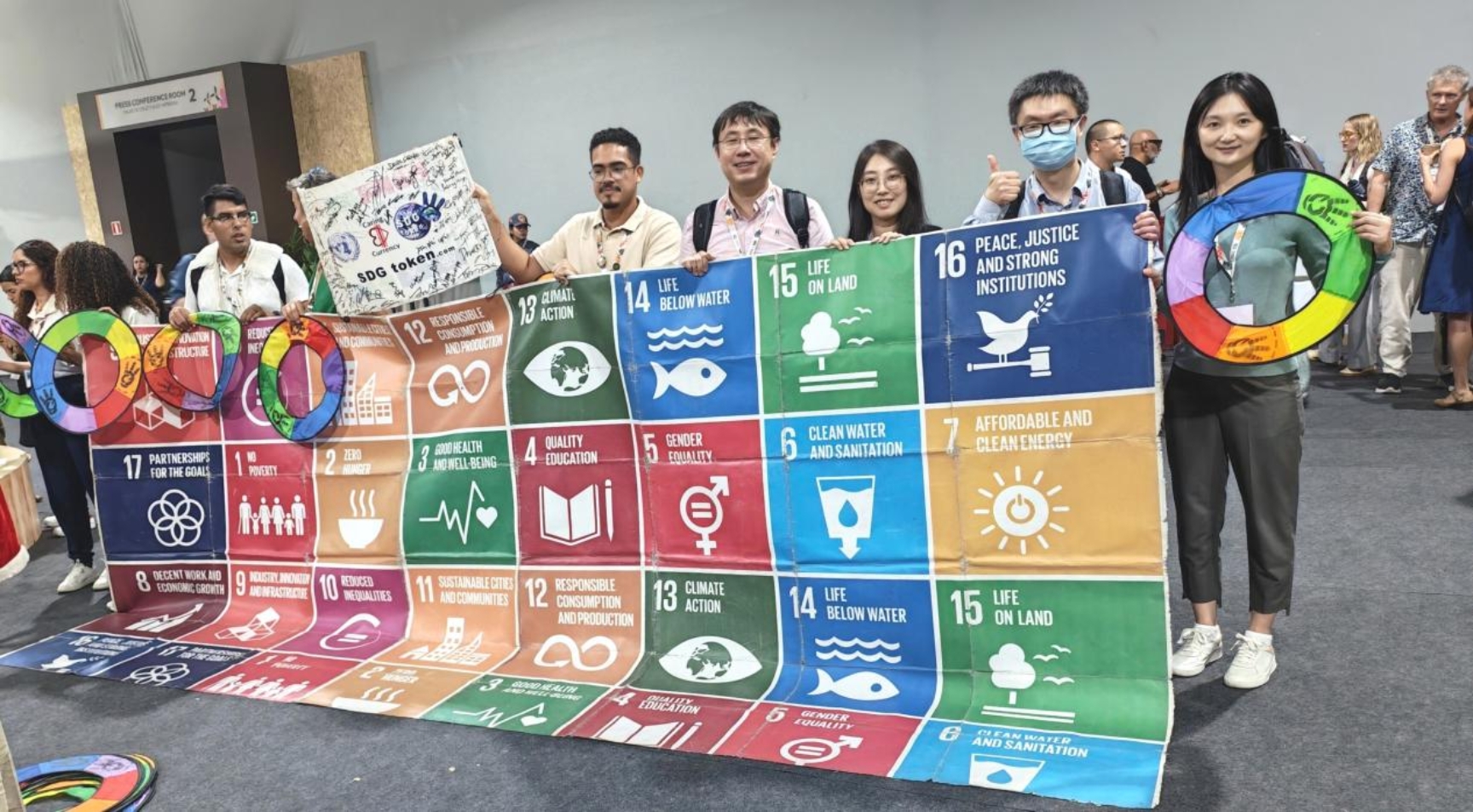
CEEP delegates took part in SDG‑themed activities on‑site.

CEEP delegates systematically presented the center’s research outputs and policy tools across multiple Pavilion events.
## Outlook
November 20 will witness the final push for finance and carbon‑market issues at COP30. Whether pledges concerning the scale of the Loss and Damage Fund, fine‑tuned rules for Article 6.4 and the fourth replenishment of the Green Climate Fund can deliver climate justice, as well as whether roadmaps for hard‑to‑abate sectors and intergenerational‑equity clauses can be adopted, will draw wide‑ranging attention from all parties.
