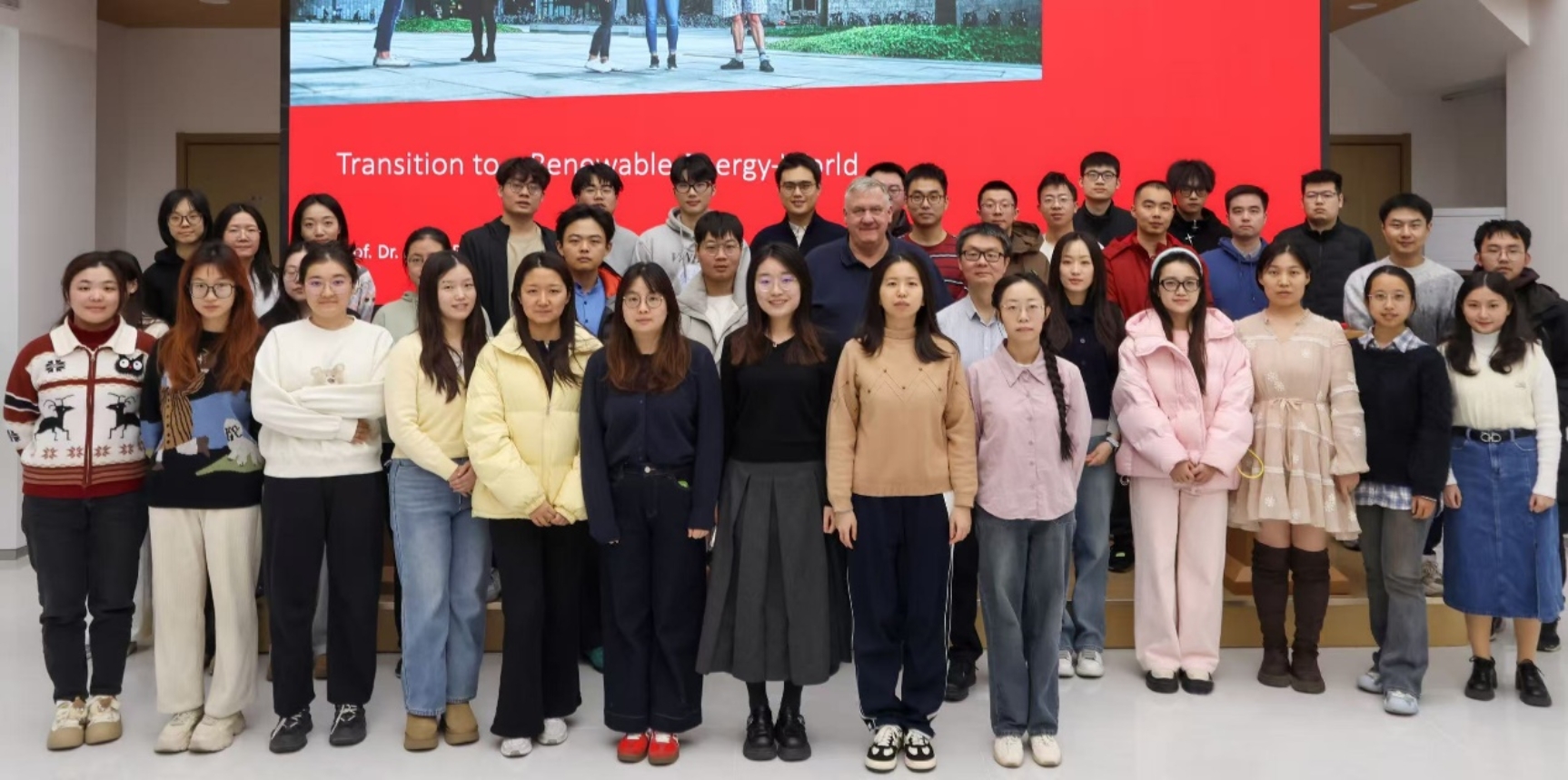
From November 30 to December 6, 2025, Professor Frank Behrendt, Fellow of the German National Academy of Science and Engineering, Professor at Technische Universität Berlin, Honorary Professor of Beijing Institute of Technology and recipient of the Chinese Government Friendship Award, paid an invited visit to the Beijing Lab for System Engineering of Carbon Neutrality at Beijing Institute of Technology.
During his visit, Professor Wei Yiming, Director of the laboratory, met and had in‑depth discussions with Professor Behrendt. Professor Behrendt exchanged views with faculty and students of the laboratory on scientific research and joint student training, and provided answers and guidance on questions raised by students regarding thesis topic selection, model construction and other issues. He also delivered three academic lectures themed Transition to a Renewable‑Energy‑Based World. Professor Wang Ke and Professor Cong Ronggang presided over the lectures respectively.
In this series of lectures, Professor Frank Behrendt first illustrated the spatial patterns of major global economies through the distribution of night‑time lights across the globe. Combined with the evolution of the global primary energy mix, demographic and urbanization trends, and changes in greenhouse‑gas concentrations, he systematically explained the urgency of energy‑system transition amid overlapping fossil‑energy constraints and climate risks. By reviewing the development history of technologies such as photovoltaics and fuel cells, he emphasized that large‑scale deployment of renewable energy builds on long‑term scientific accumulation, and comes about through the combined effects of institutional frameworks, market mechanisms and social innovation.
In the second lecture, against the backdrop of falling costs and rapidly expanding installed capacity of global wind and solar power, he analyzed the structural transition of energy systems from fossil fuels to renewables. He briefly sorted out institutional and infrastructure constraints to the transition from the perspectives of energy security, equity, sustainability and geopolitics, pointing out that under a high‑share renewable‑energy scenario, reconstructed infrastructure including new‑generation power grids, energy storage and cross‑regional interconnections is required to guarantee system flexibility and reliability.
In the third lecture, he reviewed the core objectives and policy evolution of Germany’s Energiewende (energy transition), and presented policy practices for renewable‑energy development, nuclear phase‑out and energy‑efficiency improvement. He discussed the emission‑reduction potential of renewable‑energy‑produced green hydrogen for heavy‑industry and transport sectors based on technical pathways including green hydrogen. Taking cross‑regional high‑voltage direct‑current power transmission as an example, he looked into the possible impacts of global energy interconnection on the large‑scale optimal allocation of clean energy. Throughout the three sessions, faculty and students on site held interactive discussions with Professor Frank Behrendt on topics such as international energy‑transition cooperation amid de‑globalization, improvement of energy‑system resilience, prospects for hydrogen‑energy development, and the deployment of CCUS.
Professor Frank Behrendt holds the Chair of Renewable‑Energy Conversion Technologies and Energy Process Engineering at Technische Universität Berlin and is Honorary Professor of Beijing Institute of Technology. He was elected Fellow of the German National Academy of Science and Engineering in 2007 and Fellow of the Swiss Academy of Engineering Sciences in 2016. He received the Chinese Government Friendship Award in 2024. Since 2008, he has served as Germany’s representative for the IEA Technology Collaboration Programme on Emissions Reduction in Combustion. His research covers reactive two‑phase flows, thermochemical conversion of biomass and combustion mechanisms. Integrating large‑scale experiments, numerical simulation and economic‑ecological assessment, he conducts energy‑system modelling research focusing on the coupling between renewable energy and power‑heat supply networks.