


From November 11 to 13, 2025, the 18th Annual Meeting of the Integrated Assessment Modeling Consortium (IAMC) was held in Rio de Janeiro, Brazil. Five delegates from the Center for Energy and Environmental Policy Research (CEEP) at Beijing Institute of Technology (BIT) attended the meeting, including postdoctoral researcher Wu Yun, and doctoral candidates Yang Bo, Zhao Yang, Wang Hao and Hu Yuxiang.
The second day of the meeting opened with two plenary presentations. The first session, chaired by Professor Massimo Tavoni from CMCC, focused on the 1.5°C warming overshoot risk and response pathways. It systematically explored how to advance the Paris Agreement goals from the dimensions of policy modeling and action design against the backdrop of potential overshoot of climate targets. The second session, hosted by Professor Saritha Sudharmma Vishwanathan from the Ahmedabad Institute of Management in India, examined the central role of natural ecosystems in future climate governance, and discussed topics including high-precision multi-scale modeling, community stakeholder engagement and innovative financing mechanisms.
A total of 8 parallel sessions were held on that day. Doctoral candidate Wang Hao delivered a presentation entitled *Health Gains from Climate-Pollution-Healthcare Synergy Fail to Reduce Widening Inequalities* at the Wellbeing session. By coupling a multi-region computable general equilibrium (CGE) model, a simplified air quality model and a health impact assessment model, he constructed a dynamic province-level integrated modeling framework of “energy-environment-health”, and quantitatively analyzed the co-benefits for health under pathways of carbon neutrality, air pollution control and healthcare improvement.
Other parallel sessions covered a wide range of topics. The SSPs session focused on scenario updates and expansion incorporating new shocks, multiple sectors and cross-scale dimensions. The Methods session explored innovations in IAM methodologies such as artificial intelligence and open science. The Justice session presented energy requirements for achieving global decent living standards and their impacts on long-term mitigation pathways. The Geopolitics & Critical Materials session examined emerging impacts and risks brought by critical material demand and trade dynamics in the energy transition.
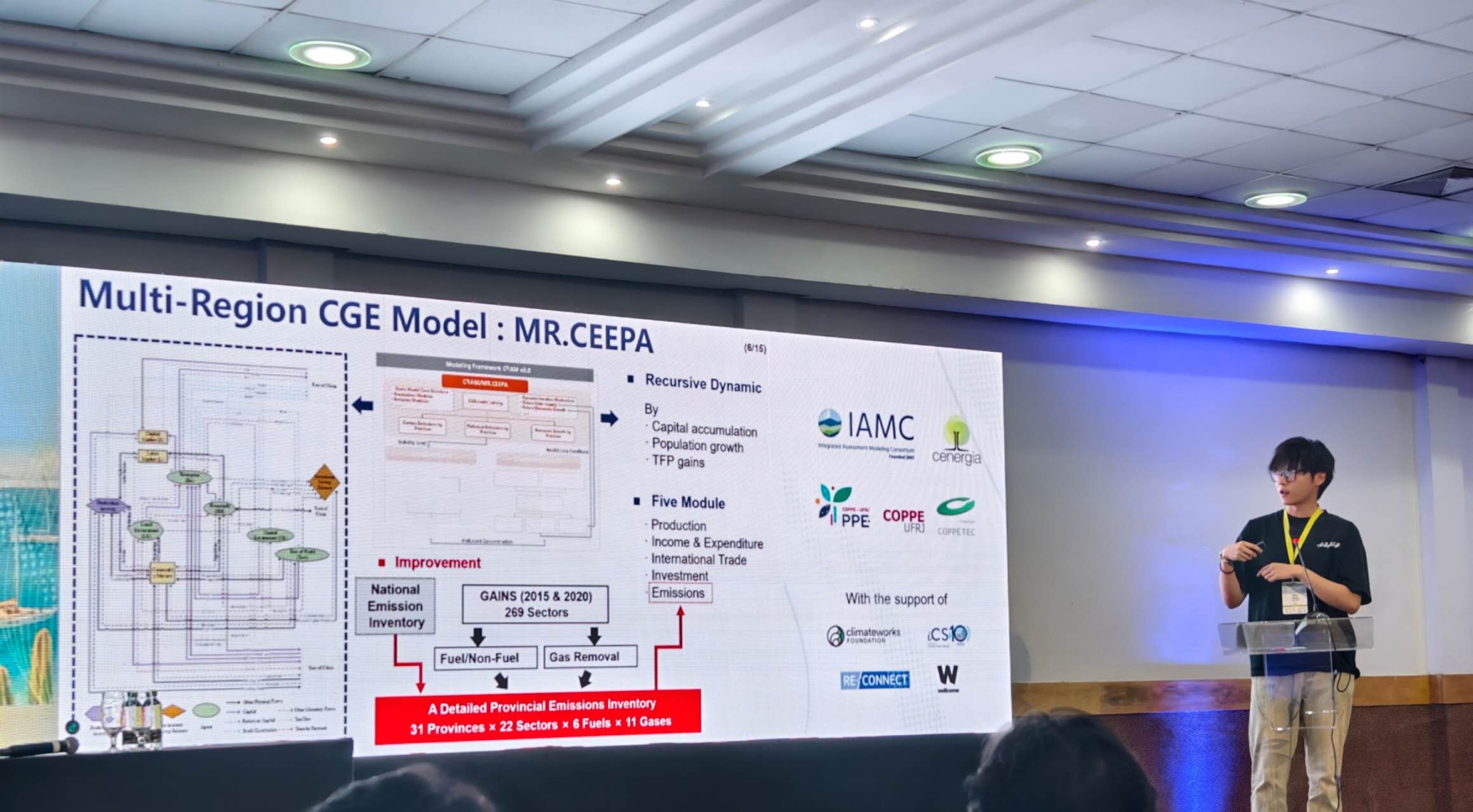
## Figure 1 On-site Presentation
During the poster session, doctoral candidate Hu Yuxiang presented his research *Global Agricultural Risk Under Climate Change—A Crop-Water Coupled Analysis Using C³IAM*. Addressing the limitations of current crop models in characterizing water dynamics and the methodological bottlenecks caused by globally uniform parameters adopted in some models, he developed a crop-hydrology coupled model within the C³IAM framework, providing a new tool for analyzing water-food nexus dynamics under climate change.
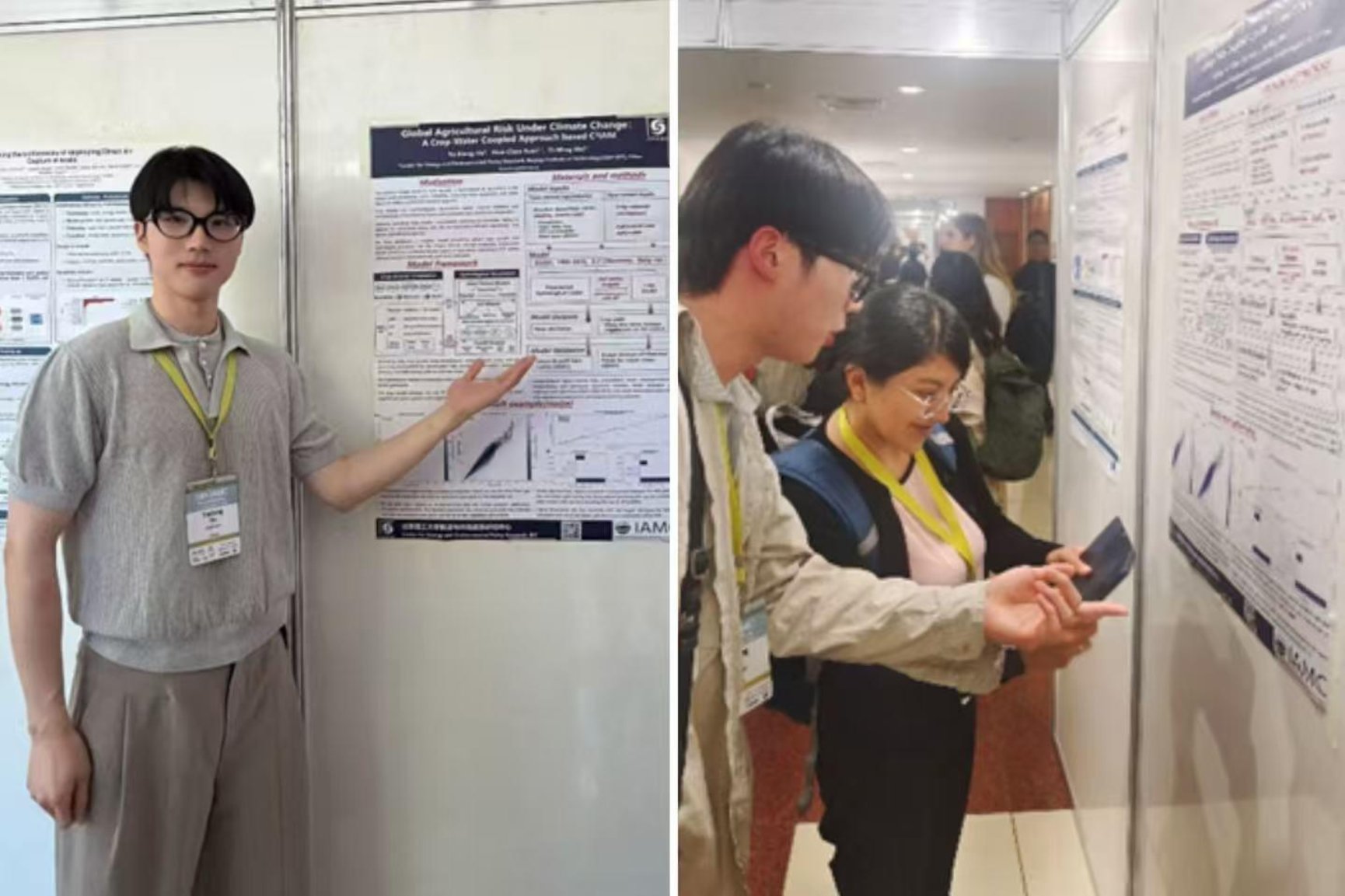
## Figure 2 Poster Display
A total of 49 cutting-edge research projects were featured in the poster session. Carl Schleussner, Leader of the Integrated Climate Impacts Group of the ECE Program at IIASA, presented *Establishing accountability for climate overshoot*. In response to the 1.5°C climate overshoot risk, he proposed a quantifiable accountability framework based on regional responsibilities, providing a key reference for the design and evaluation of next-generation IAM models.
Dr. Alaa Al Khourdajie, a researcher from Imperial College London, presented the poster *Navigating the unexpected: The impact of disruptive events on mitigation scenarios*. He established an analytical framework of “disruptive events – resilience pathways”, providing a structured approach to systematically integrating sudden disruption events into climate mitigation scenarios, and revealed the key trade-offs between technology deployment and system risk resistance.
CEEP delegates participated actively throughout the session and held in-depth discussions on a wide range of research topics.
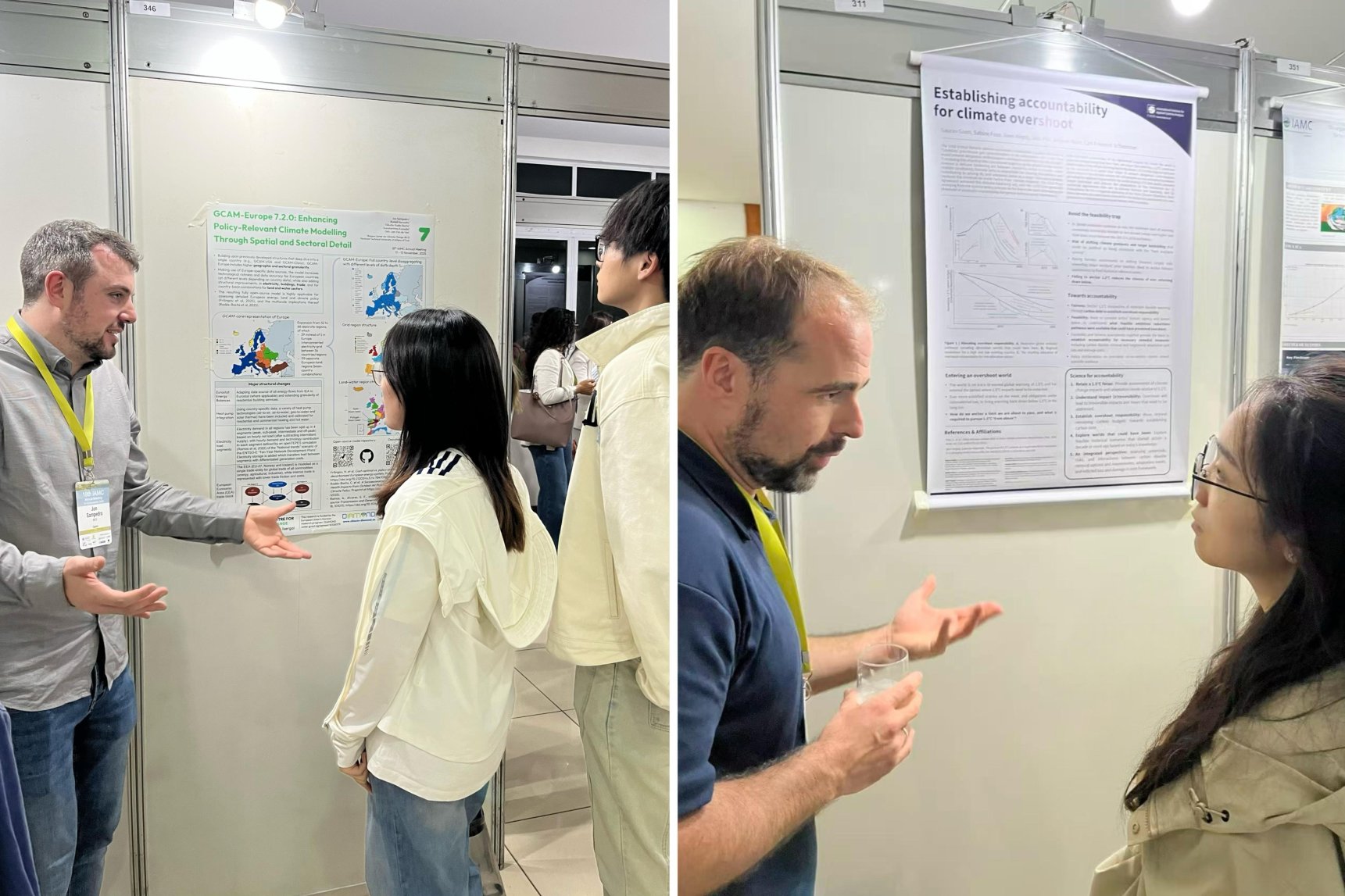
## Figure 3 Poster Exchange
Through full-day multi-session academic exchanges, CEEP team members gained valuable insights into model construction methodologies, cutting-edge issue framing and interdisciplinary collaboration. On the third day of the meeting, multiple thematic presentations and scenario analysis discussions will continue, and the team will further engage in exchanges to expand international cooperation networks.
