This week, doctoral students from the center actively took part in academic lectures and research exchanges hosted by their overseas host institutions during their visiting studies, engaging in in‑depth discussions on cutting‑edge research topics and interim research progress.
Yang Bo: Attends IIASA Academic Lecture and MESSAGEix Team Mid‑Year Review Meeting
On September 1, doctoral student Yang Bo attended the IIASA academic lecture Mapping the Feasibility Space of a 1.5 °C Future with a Million AI‑Generated Pathways. The lecture focused on generating one‑million‑plus climate scenarios with artificial intelligence to assess the feasibility space for achieving the 1.5 °C temperature target globally and across the R10 regions. The presentation introduced a physics‑constrained generative deep‑learning framework and defined multi‑dimensional regional feasibility constraints covering technology deployment, energy‑system transition, demand dynamics and emission‑reduction responsibilities. During the session, Yang Bo discussed with the speaker the mechanisms behind designing regional feasibility and equity metrics for climate goals.
In addition, on September 3, he joined the semi‑annual review meeting of the MESSAGEix team within the ECE Group. Representing the ALPS project, he presented research advances on climate‑adaptation work within integrated‑assessment‑modeling (IAM) and exchanged views with participants on model improvements and data requirements. These activities have broadened Yang Bo’s research horizons and provided useful references for his subsequent work.
Zhang Ruining: Presents at EPRG Research‑Progress Exchange Meeting
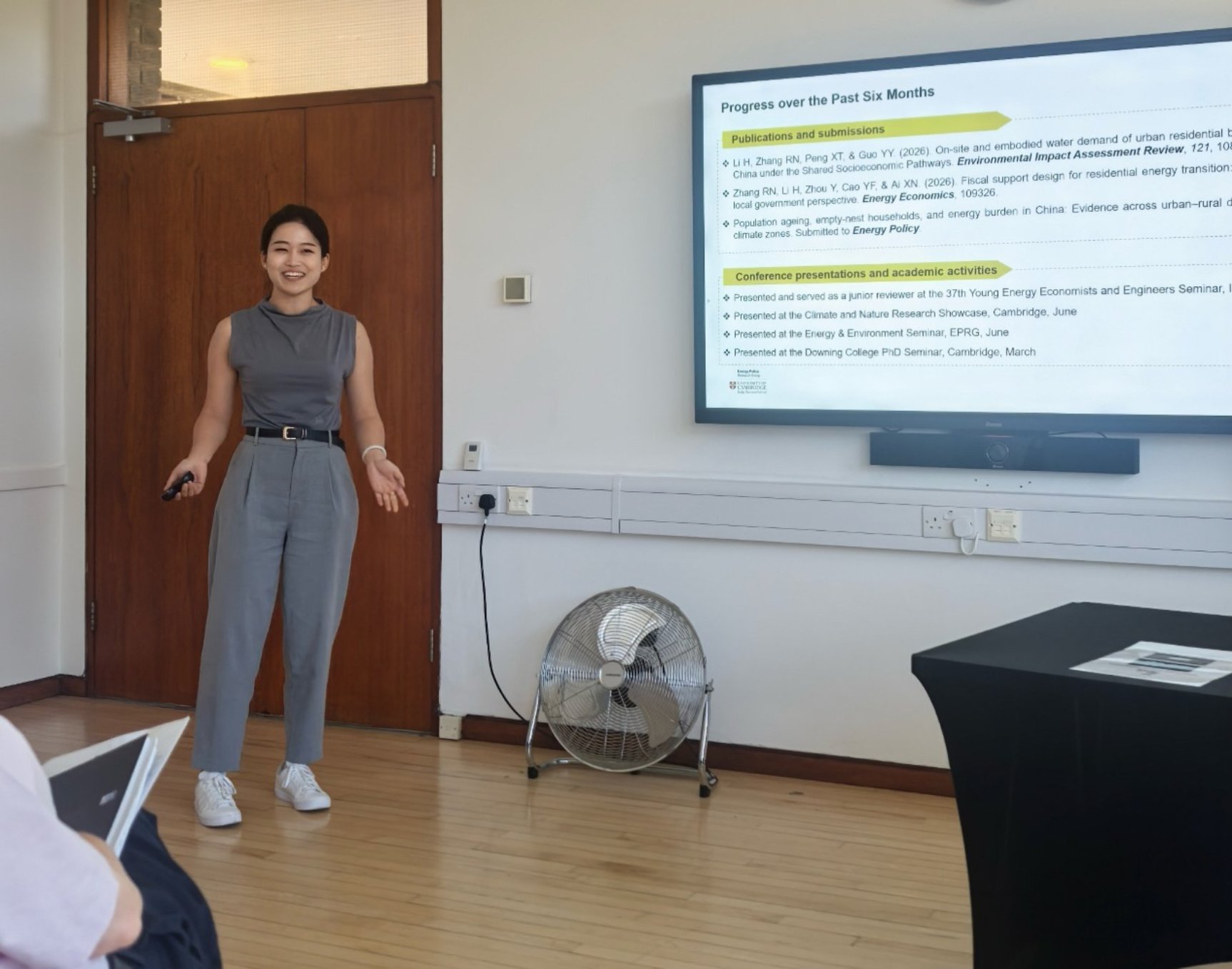
On September 1, doctoral student Zhang Ruining attended the research‑progress exchange meeting held by the Energy Policy Research Group (EPRG) at the University of Cambridge. At the meeting, EPRG professors, postdoctoral researchers, PhD students, visiting scholars and administrative staff collectively reported on research achievements over the past six months and plans for the next phase, followed by discussions on relevant research questions.
Zhang Ruining summarized her progress in research and academic exchanges during the past six months, with a focus on collaborative research into household‑appliance energy‑efficiency improvement. She also outlined her overall plans for paper submissions, PhD thesis refinement and follow‑up research work. Participants offered comments and suggestions regarding her research content and future agenda.
This marked Zhang Ruining’s final formal group academic event at EPRG before concluding her visiting stay in Cambridge. She expressed gratitude to her supervisor and team members for their guidance and support throughout her one‑year overseas visit. This exchange helped Zhang Ruining further organize her interim research outputs and priorities for future work, laying a solid foundation for continuing collaborative research and sustaining academic interactions.