


The BIT Center for Energy and Environmental Policy Research (CEEP-BIT) attaches great importance to the international cultivation of talents, encouraging students to engage with the world’s top universities and research institutions to broaden their academic horizons and build cross-border research collaborations. Currently, more than ten doctoral students from the center are pursuing joint training at prestigious universities and research institutions across Europe, North America, Australia and other regions. Through active participation in international conferences, in-depth research group seminars and extensive academic exchanges, doctoral students absorb frontier knowledge and refine their research capabilities. The following is the latest update on overseas academic visits.
Academic Visit Updates
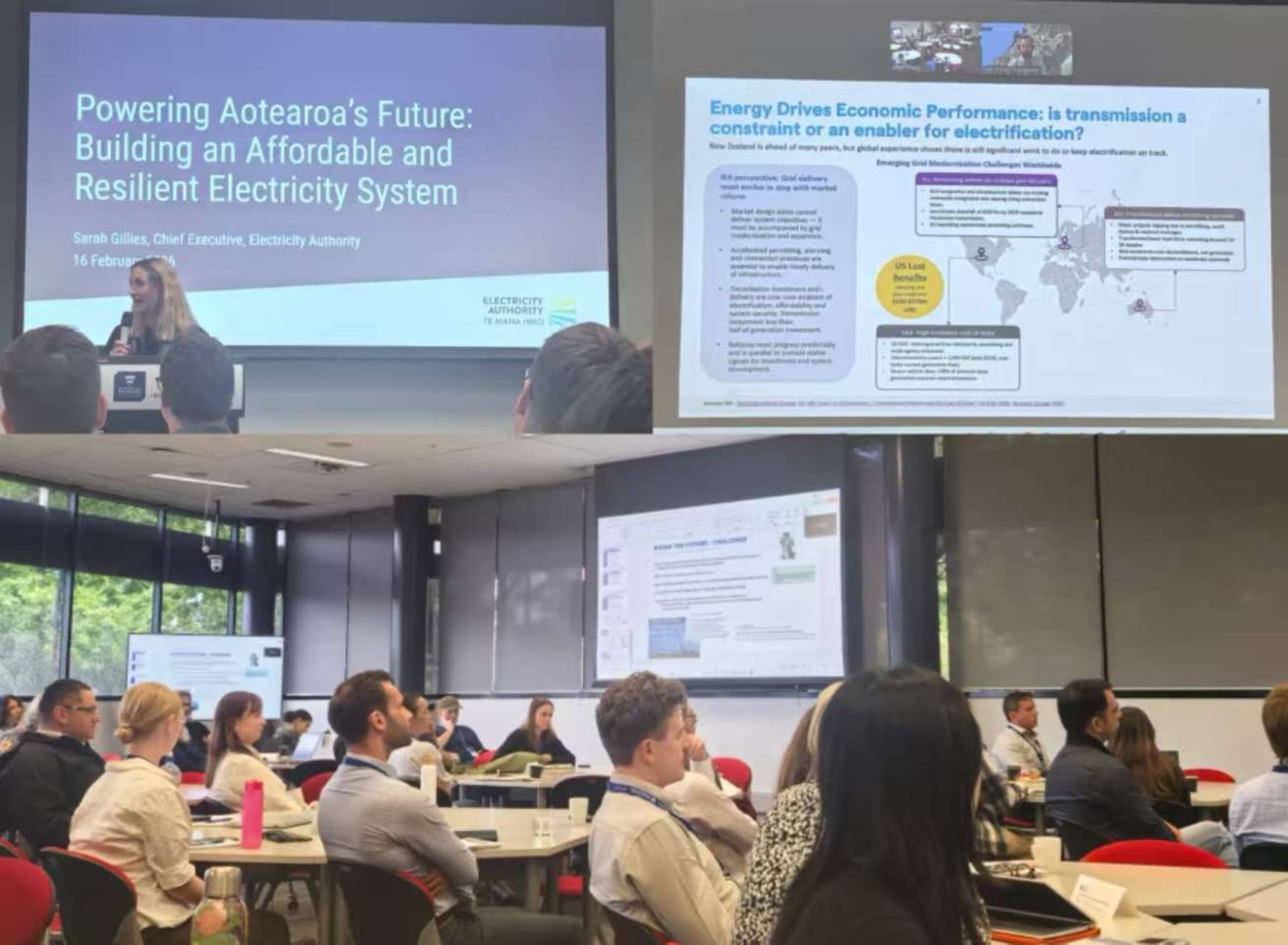
Cai Qiran attended the Energy Economics Summer School hosted by the Energy Centre at the University of Auckland. The program is open free of charge to students and practitioners in the energy sector, aiming to help participants gain a systematic understanding of the energy industry’s development landscape and the full range of challenges on the path toward net-zero emissions. Structured as roundtable sessions, the summer school featured multiple expert presentations and interactive discussions centered on core issues shaping the future energy landscape. Topics covered the energy trilemma, current status and outlook of power systems, renewable energy development, electricity demand response, energy efficiency, the application and impacts of artificial intelligence, transmission system resilience, as well as flexible and distributed energy development. Through exchanges with experts, scholars and industry practitioners, Cai Qiran deepened his understanding of the technical pathways for power system transformation, particularly in electricity demand response mechanisms, system resilience enhancement and distributed energy advancement.
Qi Jiahong attended a thematic lecture titled Mode shift in NSW: Making public and active transport the first choice. Trudi Mares, Deputy Secretary of the New South Wales Department of Transport, systematically presented NSW’s practical pathways for advancing travel mode shift under the priority strategy for public transport and active travel. Backed by data analysis, the presentation illustrated changing trends in commuter behavior, identified key barriers to public transport attractiveness such as accessibility and service frequency, and put forward targeted improvement measures. The lecture also elaborated on the positive role of metro and light rail in upgrading travel experience and expanding transport options. Overall, NSW guides residents toward low-carbon, sustainable travel modes through a multi-modal, data-driven policy framework, which offers important insights for understanding transport emission reduction and behavioral steering.
Yang Bo participated in the seminar ICONICS - Scenario Evolution Process of the Shared Socioeconomic Pathways. The Scenario Evolution Process (SEP) is a scientific community initiative coordinated by the Scenario Committee for Integrated Assessment of Climate Change, designed to examine the application of Shared Socioeconomic Pathways (SSPs) and design the evolution framework for future SSP pathways. Chaired by Professor Kristie Ebi from the University of Washington, the seminar brought together scholars including leading IIASA researcher Bas van Ruijven, who shared the design concepts, vision and implementation progress of SEP. Participants held thorough discussions on how to develop a new generation of scenario frameworks that are more equitable, inclusive and practice-oriented. In addition, Yang Bo had multiple rounds of discussions with his overseas supervisors Edward Byers and Giacomo Falchetta on socioeconomic factors that influence the adaptation gap and adaptation effectiveness.
