


The BIT Center for Energy and Environmental Policy Research (CEEP-BIT) attaches great importance to the international cultivation of talents, encouraging students to engage with the world’s top universities and research institutions to broaden their academic horizons and build cross-border research collaborations. Currently, more than ten doctoral students from the center are pursuing joint training at prestigious universities and research institutions across Europe, North America, Australia and other regions. Through active participation in international conferences, in-depth research group seminars and extensive academic exchanges, doctoral students absorb frontier knowledge and refine their research capabilities. The following is the latest update on overseas academic visits.
Academic Visit Updates
Wang Xiaokun attended the Climate Tech at Duke Showcase: Duke Climate Collaboration Symposium hosted by the Nicholas Institute for Energy, Environment & Sustainability at Duke University. Centered on climate technology and interdisciplinary collaboration, the event featured focused presentations and exchanges covering clean energy systems, energy storage and grid optimization, low-carbon materials, carbon capture and utilization, and the application of artificial intelligence in climate governance and industrial transformation.
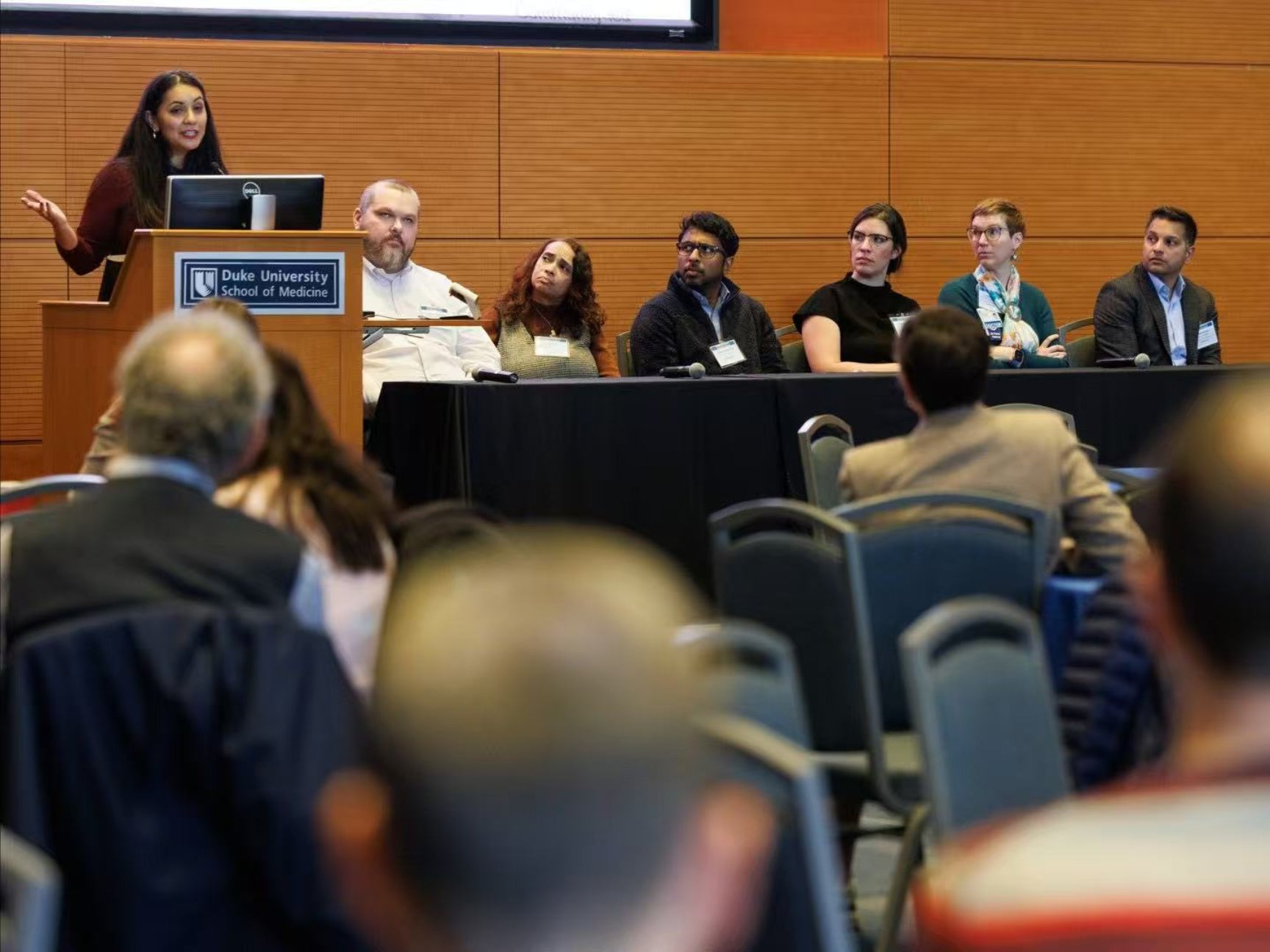
Through a series of short thematic talks and project showcases, the event presented Duke University’s latest advances in climate technology R&D, prototype verification and industry-university cooperation. Participating scholars and enterprise representatives held discussions on technical feasibility assessment, achievement transformation pathways, cross-school collaboration mechanisms and specific models for industry alignment. Through this exchange, Wang Xiaokun further deepened his understanding of the critical links in translating climate technologies from research to real-world application, gained a clearer perspective on the "technology-policy-industry" coordinated research pathway, and obtained concrete references for follow-up related research.
Qi Jiahong attended an academic report on synthetic population generation methods for travel demand modeling. The report proposed a minimum-sample approach based on Gaussian processes, which can reconstruct a complete synthetic population and travel demand structure with only around 1% of observed data. This method can simultaneously characterize trip chains, travel modes, departure times and socioeconomic attributes, preserve the complex correlations between variables, and quantify the uncertainty of each variable, thereby improving the reliability assessment of time-varying OD matrices. Compared with traditional methods such as Iterative Proportional Fitting (IPF), this framework delivers higher data efficiency and offers new ideas for future travel survey design and sample size optimization.
Peng Song attended the departmental meeting of the ES Division at the Copernicus Institute of Sustainable Development, where he introduced himself and exchanged views with newly recruited research fellows. He also participated in the Lunch Seminars held by the E&R Division, themed Spatial Inequality of Water-Energy-Food (WEF) Security and Health in South Africa. The speaker Earl presented a series of studies on spatial disparities in WEF security and health in South Africa under the context of climate change, and further proposed a typological framework for WEF intervention measures. In addition, he attended the opening ceremony of the Hydrogen Energy Laboratory at Utrecht University (UU), and toured the electrolyser and catalyst R&D laboratories. His participation in diverse activities allowed him to experience the innovative atmosphere of multidisciplinary intersection.
