


From July to August 2026, multiple doctoral students of the center attended internal seminars and lectures hosted by their overseas host institutions, engaging in exchanges and learning on cutting‑edge topics including climate change and the construction of resilient energy systems.
Qi Jiahong Attends "Transport Network Resilience" Thematic Lecture and Other Events

On July 5, doctoral student Qi Jiahong took part in a seminar on transport‑network resilience and viewed the featured presentation Resilience of Multimodal Urban Transportation to Compound Flooding. Focusing on the impacts of compound flooding on urban multimodal transport systems, the talk demonstrated how to combine climate‑risk analysis, complex‑network science and data‑driven methods to evaluate the vulnerability, cascading‑failure risks and recovery capacity of interconnected transport networks such as roads and rail transit under extreme‑disaster scenarios. The presentation offered insights into urban‑transport‑system resilience under climate change and supplied fresh perspectives for transport research from the viewpoint of multi‑network interconnection and multi‑hazard risks.
On July 30, Qi Jiahong joined the HDR Research Discussion Meeting hosted by the Institute of Transport and Logistics Studies (ITLS), University of Sydney. The seminar centered on transport equity and micromobility policies. Two speakers presented the latest research advances in modelling walking equity and micromobility regulatory policies respectively. The first presentation adopted structural‑equation modelling and multi‑group analysis to explore how opportunities, benefits and burdens shape walking equity. From a social‑equity standpoint, the second analysed potential unintended equity‑related consequences of Australia’s micromobility safety regulations, emphasizing that traffic‑safety and equity goals should be addressed jointly. This academic exchange deepened his grasp of transport‑equity theories, behavioural‑modelling techniques and transport‑policy evaluation.
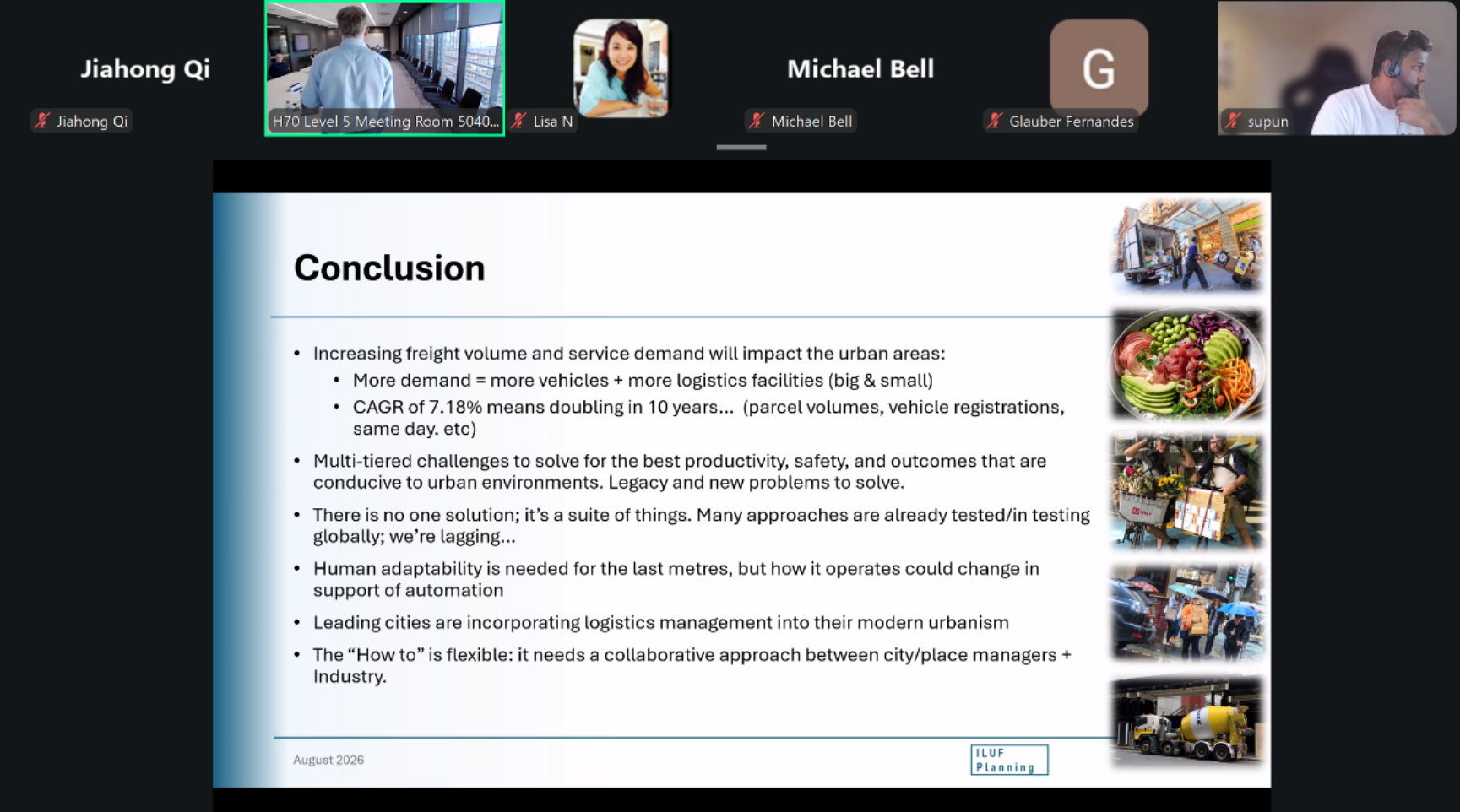
On August 5, Qi Jiahong participated in the Leadership, Policy and Research Seminar organised by ITLS at the University of Sydney. Delivered by Michael Stokoe from ILUF Planning, the lecture was titled Shaping the Next Decade: Urban Freight Growth and the Future of Industrial Land. Against the backdrop of rising urban‑freight demand over the next decade, the presentation covered industrial‑land planning and logistics‑system transformation. It highlighted commercial‑vehicle electrification, evolving last‑mile delivery models, smart‑logistics planning, and the coordinated optimisation of urban freight and land‑use. Frontier subjects including digital management, dynamic delivery scheduling, logistics‑facility layout optimisation and low‑carbon transport development were also discussed. The event enhanced his understanding of the synergies between sustainable urban‑freight‑system development and transport planning, and inspired new research ideas for low‑carbon‑transport and urban‑logistics studies.
On August 31, Qi Jiahong attended the Thesis Proposal Defence academic session held by ITLS, University of Sydney. The presentation, entitled Upstream, Midstream, or Downstream? AI Value Chain Position and Cross‑Border Venture Investment in AI Startups, explored the link between an AI firm’s position along the industrial value chain and cross‑border venture‑capital activity. From an AI‑value‑chain perspective, the study categorises AI startups into upstream infrastructure providers, mid‑stream foundation‑model or general‑AI developers, and downstream AI‑application enterprises. It further analyses how value‑chain positioning affects foreign‑investor participation, foreign‑capital intensity and investor geographic diversity. Attending this talk improved his awareness of research approaches for AI‑industrial‑chain segmentation, cross‑border investment and firm innovation, and deepened his comprehension of formulating research questions and conducting empirical analysis from a value‑chain perspective.
Cai Qiran Attends Academic Report Match and Smooth: Designing Highly Renewable Electricity Systems and Additional Activities
Doctoral student Cai Qiran attended the academic lecture Match and Smooth: Designing Highly Renewable Electricity Systems, organised by the Energy Centre at the University of Auckland Business School. The speaker was Professor Michael Jack, Director of the Sustainable Energy Programme within the Department of Physics at the University of Otago.
The lecture focused on designing power systems with high shares of renewable energy and identified two overarching design objectives: matching variable power supply to variable demand, and smoothing supply‑and‑demand peaks so as to realise efficient infrastructure utilisation. Two major technical pathways can achieve these goals: flexibility regulation enabled by energy storage and demand‑side response, and resource aggregation via interconnected shared power grids. Drawing on recent research outputs, the speaker illustrated these solutions with real‑world examples, including optimisation comparisons between household‑ and community‑scale energy‑storage capacity, quantitative evaluation of peak‑load reduction brought by aggregation, and targeted energy‑efficiency interventions for mitigating seasonal supply‑demand imbalances. Addressing cutting‑edge energy‑transition themes, the lecture offers meaningful insights for planning and operating high‑renewable power systems.
Cai Qiran also took part in the University of Auckland Open Day. Through faculty exhibitions, themed lectures, interactive experiences and staff‑student conversations, the event showcased teaching‑research environments, disciplinary strengths and campus culture. The Business School hosted a series of themed sessions covering everyday economic decision‑making and its social impacts, how data analysis unlocks insights and generates impact, exploring digital‑and‑information‑systems, and artificial‑intelligence applications in university study. In addition, participants could visit the BNZ Financial Trading Room to experience real‑world financial‑trading settings. Through these lectures and hands‑on activities, Cai Qiran gained further understanding of how the University of Auckland Business School integrates domain knowledge, digital‑technology literacy and practical‑competence development in its programmes.
Wang Xiaokun Joins Summer Academic Workshops and Other Activities
On July 15 and August 15, Wang Xiaokun attended successive summer academic workshops hosted by his overseas supervisor’s research group. He exchanged views with faculty members, doctoral candidates and early‑career researchers on frontier topics in energy economics, energy systems and climate policy.
During the workshops, group members shared ongoing research projects. Discussions covered rising electricity demand driven by rapid expansion of artificial‑intelligence and data‑centre infrastructure, cost‑and‑economic‑performance comparisons for alternative energy‑supply schemes, low‑carbon‑energy‑infrastructure investment, and energy‑system transition. Building on the group’s recent work, participants focused on the potential impacts of emerging electricity loads such as data centres on power‑system planning and energy investment, and how cost accounting, scenario analysis and data modelling can be used to compare different energy technologies and supply options. Conversations also touched on policy design under energy transition, market‑actor behaviours and their economic consequences.
In dedicated research‑discussion segments, Wang Xiaokun presented interim findings from his energy‑and‑climate‑policy research conducted during his overseas visit. He solicited feedback on policy‑indicator construction, data processing, empirical‑model specification and result interpretation. Group members offered suggestions from diverse standpoints and discussed economic‑mechanism identification, market‑agents’ responses to policy shifts, and directions for follow‑up analysis. Featuring research presentations, problem‑oriented discussions and open‑forum exchanges, the two summer workshops provided a productive platform for team members to share research progress and swap academic viewpoints.
On August 25, Wang Xiaokun took part in the Macro Breakfast academic event hosted by the Department of Economics, Duke University. Macro Breakfast is a small‑scale internal exchange event for economics PhD students and faculty. Centred on PhD students’ research presentations and open discussion, it offers opportunities for doctoral candidates to present preliminary results, receive feedback from faculty and peers, and share research experience. Organised by Duke economics Professor Cosmin Ilut, this session featured a research presentation by economics PhD candidate Zhaosheng Li, followed by joint discussion among attending faculty and doctoral students.
The session focused on macroeconomics and labour‑market research, including corporate hiring decisions, labour‑market power, and employment‑unemployment dynamics. Attendees debated research assumptions, model specifications, underlying economic mechanisms and result interpretation, and further explored how firm‑level behaviours connect to aggregate labour‑market changes. After the event, Wang Xiaokun talked with economics PhD peers about doctoral‑stage research training, advancing working papers, delivering academic presentations and general research experience. He learned more about how the Duke University Department of Economics organises PhD‑level academic exchanges and research training.
